
Do More Construction Hoists Actually Make a High-Rise Project Faster?
Short answer: Adding construction hoists can reduce waiting and transportation bottlenecks, but more hoists do not automatically produce a faster project. Research on high-rise construction shows that hoist quantity, location, zoning, cage configuration, traffic demand and operating strategy must be considered together.
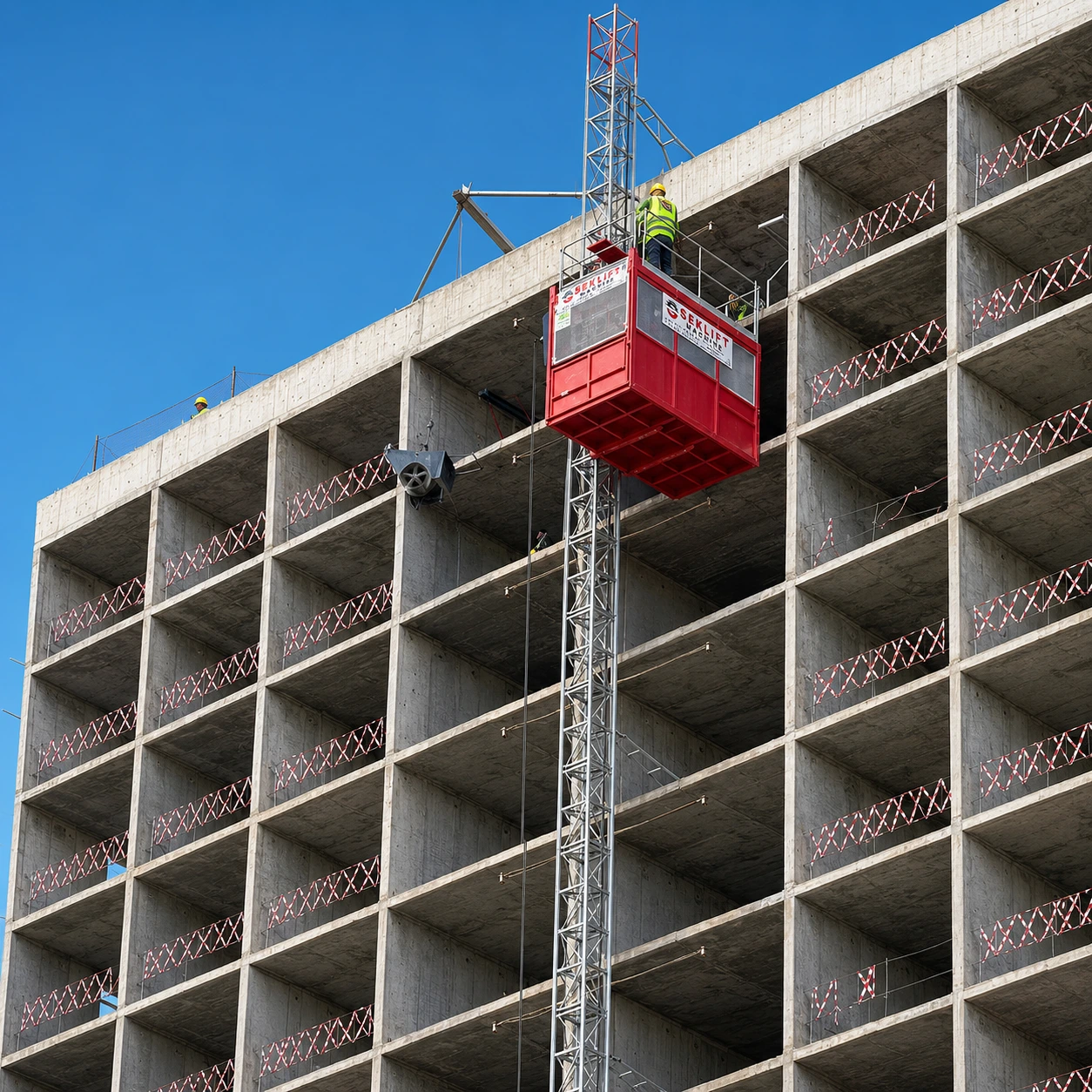
In other words, the real question is usually not:
“How many construction hoists can we install?”
It is:
“What vertical-transportation system can move the required workers and materials with the least delay and unnecessary capacity?”
That difference matters more as buildings become taller.
A qualification is important from the beginning. Most of the research reviewed here measures vertical-transportation time, passenger waiting time, lifting time, operational efficiency, logistics cost or hoist utilization rather than total high-rise project completion duration. Improvements in these metrics can remove an important project bottleneck, but they should not be interpreted as equal percentage reductions in overall construction duration.
Evidence note: This article draws on peer-reviewed research using construction-hoist simulation, mathematical and mixed-integer optimization, BIM-based demand estimation, high-rise case-project and field data, and experimental control-system testing. These methods answer different questions and are not all direct before-and-after field measurements. Because building layouts, traffic demands, hoist configurations, costs and objective functions differ, numerical improvements are specific to the evaluated conditions rather than universal performance guarantees. Several studies also come from related high-rise construction research programs, so their results are best read as complementary evidence rather than fully independent universal replications.
Why construction hoists can become a project bottleneck
On a low-rise project, moving workers and materials between floors may consume relatively little time.
On a high-rise construction site, vertical transportation becomes part of the production system itself.
Workers must reach their assigned floors. Tools and smaller materials must arrive when required. Multiple trades may request transportation simultaneously. Demand also changes during the day and as construction progresses upward.
If the hoist system cannot handle that demand, workers can spend productive time waiting rather than working.
Park et al. examined this problem through a simulation model applied to a high-rise residential case project. Their research treated worker vertical transportation as a changing demand problem rather than a fixed-capacity calculation. (Park et al., 2013)
This creates an understandable response:
install another hoist.
Sometimes that is exactly the correct answer.
But not always.
Why adding another hoist does not guarantee better performance
Every additional construction hoist brings more lifting capacity, but it also introduces constraints.
A project has limited:
- façade and installation space,
- landing locations,
- electrical capacity,
- access routes,
- installation and dismantling time,
- rental and operating budget,
- and usable ground-level loading areas.
There is also the problem of utilization.
A construction site may theoretically have enough lifting capacity but still suffer long waiting times because the hoists are serving the wrong floors, making inefficient trips or handling highly uneven demand.
This is why construction-hoist research increasingly treats planning as a simulation and optimization problem rather than simply an equipment-count problem.
Shin, Cho and Kang developed a discrete-event simulation model combined with genetic algorithms for temporary-hoist planning and applied it to a real high-rise project. Their work specifically addressed the difficulty of selecting among different hoist arrangements when simple formulas cannot adequately represent the available alternatives. (Shin et al., 2011)
Cho et al. later developed and simulation-verified a multi-lifting operating algorithm for super-tall construction, incorporating factors such as lift acceleration and deceleration rather than relying only on planner experience. (Cho et al., 2013)
Koo et al. approached vertical transportation as a multi-objective optimization problem involving operating time, cost effectiveness and electricity consumption during peak worker traffic. (Koo et al., 2016)
More recent work follows the same direction.
Jawaheri, Ahmadnia, Maghrebi and Ghanbari developed a mixed-integer linear programming model that optimizes the type, number and location of lifts at different project stages while considering daily rental and operational costs, horizontal material movement, installation and dismantling, and delay penalties. The model was tested using field data from a real-world project rather than as a direct before-and-after field experiment. (Jawaheri et al., 2026)
The important point is not one particular optimization algorithm.
It is that the optimized number and configuration of hoists can change according to project stage and transportation demand.
Hoist zoning can matter as much as hoist quantity
Imagine a high-rise project with several construction hoists.
One approach is to allow every hoist to respond to requests from nearly every floor.
Another is to divide the building into zones.
For example:
- one hoist or group serves lower floors,
- another serves intermediate floors,
- another primarily serves upper levels.
The purpose is to reduce unnecessary travel and stops.
Park et al. investigated this approach using a simulation model applied to a high-rise residential case project, with zoning adjusted according to changing worker lifting demand.
In that specific case-study simulation, the optimized zoning configuration reduced vertical transportation time by 43%. (Park et al., 2013)
That does not mean the building was constructed 43% faster.
It also does not mean zoning will reduce transportation time by 43% on another project.
It demonstrates something more useful:
the same lifting equipment can perform very differently depending on how it is organized.
That is why simply comparing the number of hoists between two construction sites can be misleading.
Double-cage construction hoists change the calculation again
The term double-cage needs some care because it can describe different physical arrangements.
Conventional twin-cage construction hoists
A conventional twin-cage construction-hoist arrangement generally uses two independently operating cages associated with a common mast system.
A conventional twin-cage arrangement can provide additional cage capacity while the cages operate around a shared mast system.
But that conventional arrangement is not the system evaluated by Kim et al. in the study cited here.
Kim et al.'s flexible double-cage concept
Kim et al. investigated a different concept derived from double-deck elevator architecture.
Their system used an upper and lower cage arranged vertically. The two cages could be joined so that they operated as a double-deck-style unit, serving adjacent levels, while a detachable adapter allowed greater flexibility when traffic patterns changed. (Kim et al., 2018)
The researchers evaluated the concept through a simulated case study using project data and different combinations of conventional single-cage hoists and the proposed flexible double-cage system.
Within the specific optimized configuration evaluated in that study, the authors reported a 7.9% increase in operational efficiency and a 16.6% decrease in total operational cost. (Kim et al., 2018)
Those percentages should not be applied to conventional twin-cage construction hoists.
They belong to Kim et al.'s particular flexible double-deck-style concept, traffic assumptions, hoist combination and simulated case.
The broader lesson remains valuable:
capacity should not be evaluated only by counting machines. Cage configuration and operating strategy also matter.
Construction-hoist demand changes while the building grows
One of the biggest problems with selecting a fixed number of construction hoists at the beginning of a project is that the project itself does not remain fixed.
Early in construction:
- transportation distances are short,
- fewer floors are active,
- certain materials dominate traffic.
Later:
- average travel distances increase,
- the workforce may be distributed across many levels,
- finishing trades can create very different transportation patterns,
- worker traffic may become more important than heavy-material traffic.
Wu et al. developed a BIM-based demand-estimation method for vertical transportation during high-rise construction. Their research emphasized that an under-designed temporary vertical-transportation system can contribute to costly delays, while an over-designed system can impose unnecessary capacity and cost. (Wu et al., 2020)
That leads to a better design question:
What lifting capacity is required during each stage of the project?
rather than:
What is the maximum number of hoists we can install?
Location matters too
The productivity of a construction hoist does not end when the cage reaches the correct floor.
Workers and materials still need to travel horizontally from the landing to the work area.
A hoist may perform efficiently in vertical transport while still increasing horizontal material-handling distance if its landing location is poorly aligned with the work areas it serves.
This interaction is one reason recent optimization research considers both hoist location and horizontal material movement.
Jawaheri et al.'s MILP model explicitly incorporates horizontal material-handling cost together with lift number, type, location, rental and operation, installation and dismantling, and delay penalties. The model was evaluated using real-project field data, but the reported outcomes remain optimization-model results rather than a controlled field before-and-after experiment. (Jawaheri et al., 2026)
The practical implication is straightforward:
a construction hoist should be treated as part of the site's logistics network, not as an isolated lifting machine.
Smarter dispatch can improve the same equipment
There is another variable that has nothing to do with buying or installing additional machines:
how the existing hoists respond to calls.
With several hoists serving many floors, inefficient dispatching can create:
- unnecessary empty trips,
- repeated stops,
- long passenger waiting times,
- uneven use between cages.
Lee and Kim investigated this problem using a deep-Q-network, a form of deep reinforcement learning.
Importantly, the study did not demonstrate an 86.7% improvement during normal commercial operation on a completed live high-rise deployment.
The researchers first trained the control policy in a virtual simulation environment using a case involving multiple hoists and a 30-storey construction setting. They then tested the learned policy through a real-world mock-up hoist simulator against other control strategies. (Lee & Kim, 2021)
Under the scenarios and control methods tested, the DQN-based system reduced passenger waiting and lifting time by up to 86.7%. (Lee & Kim, 2021)
That result does not mean:
AI makes construction 86.7% faster.
Nor does it establish that every construction hoist operated with an intelligent controller would achieve the same improvement.
The useful finding is narrower and stronger:
operational control can materially influence hoist performance even when the physical lifting equipment remains unchanged.
So, when does a project actually need another construction hoist?
There is no universal floor count or building height at which another hoist automatically becomes necessary.
The decision depends on variables such as:
| Variable | Why it matters |
|---|---|
| Височина на сградата | Greater travel distances increase cycle time. |
| Workforce size | More workers create higher passenger demand, particularly during shift changes. |
| Number of active floors | Widely distributed trades create more destinations and stops. |
| Material demand | Different construction phases generate different lifting requirements. |
| Hoist speed | Travel speed influences cycle time but is only one part of system performance. |
| Cage capacity | Determines how much personnel or material can move during each trip. |
| Cage configuration | Single, conventional twin-cage and other arrangements produce different operational possibilities. |
| Landing arrangement | More stops can increase travel and door-cycle time. |
| Hoist location | Affects horizontal movement after the load leaves the cage. |
| Traffic control | Poor dispatching can waste available capacity. |
| Project phase | Demand changes as construction progresses upward. |
This is why sophisticated construction-hoist planning increasingly relies on simulation, project data, mathematical optimization and BIM-supported demand estimation.
Jalali Yazdi, Maghrebi and Bolouri Bazaz, for example, developed a mixed-integer programming optimization model integrating task attributes, project schedules, required resources, lift specifications and building conditions. The model was tested with real data from a 34-storey construction project and used to solve the vertical-transportation planning problem rather than directly measuring a before-and-after productivity change on site. (Jalali Yazdi et al., 2018)
More capacity and better productivity are not the same thing
This distinction is the central lesson.
Installing another construction hoist increases theoretical transport capacity.
But project performance depends on whether that capacity solves the actual constraint.
If workers are waiting because there is simply insufficient lifting capacity, another cage may produce a meaningful improvement.
If delays are instead caused by poor zoning, inefficient dispatching, badly positioned landings or uneven traffic distribution, increasing equipment quantity may leave much of the underlying inefficiency untouched.
The academic literature therefore points toward a more useful concept:
construction-hoist performance is a system-design problem.
The number of machines matters.
So do:
- their capacity,
- their configuration,
- their placement,
- the floors they serve,
- when they operate,
- what they carry,
- and how calls are assigned.
The better question for contractors
Instead of asking:
“How many construction hoists do we need?”
contractors and planners may get a better answer by asking:
“What combination of hoist quantity, capacity, location and operating strategy will meet our changing vertical-transportation demand with acceptable waiting time and cost?”
That question is more complicated.
But it also reflects how high-rise construction actually works.
A construction hoist is not simply a machine attached to the side of a building.
On a large project, it becomes part of the project's logistics infrastructure.
And once vertical transportation becomes a constraint on labor and material flow, improving that system can be as important as increasing its nominal lifting capacity.
Frequently Asked Questions
Does adding more construction hoists make a project faster?
It can improve vertical-transportation performance when existing lifting capacity cannot meet worker or material demand. However, research also shows that zoning, location, cage configuration and operating strategy can materially affect waiting time, lifting performance and logistics cost.
Most research measures those intermediate logistics outcomes rather than total project completion duration, so an improvement in hoist performance should not automatically be translated into the same percentage reduction in overall construction time.
How many construction hoists does a high-rise building need?
There is no universal number.
Hoist requirements depend on building height, workforce, material demand, active floors, cage capacity, travel speed, site layout, traffic patterns, project phase and acceptable waiting time.
Simulation and optimization research therefore focuses on finding a suitable configuration for the actual project rather than prescribing one fixed hoist-to-floor ratio.
Is a double-cage construction hoist more efficient than a single-cage hoist?
Additional cage capacity can potentially improve throughput, but actual efficiency depends on traffic demand, physical configuration, operating strategy, site constraints and dispatching.
A distinction is also necessary between a conventional twin-cage construction hoist, with independently operating cages associated with a common mast system, and the flexible double-deck-style concept investigated by Kim et al.
Kim et al.'s reported 7.9% operational-efficiency increase and 16.6% operational-cost reduction apply only to the specific optimized flexible double-cage configuration evaluated in their simulated case study. They are not general performance figures for conventional twin-cage construction hoists. (Kim et al., 2018)
Can construction-hoist zoning reduce waiting or transportation time?
Yes, under suitable conditions.
Park et al. used a simulation model on a high-rise residential case project and reported a 43% reduction in vertical transportation time for the optimized zoning configuration. The result concerns transportation time in that particular simulation and does not mean the overall building project became 43% faster. (Park et al., 2013)
Can AI improve construction-hoist efficiency?
Research suggests intelligent dispatch systems can improve lifting performance by reducing unnecessary trips and passenger waiting.
Lee and Kim trained a deep-reinforcement-learning controller in simulation and subsequently evaluated it through a real-world mock-up hoist simulator. Under the tested scenarios and comparison control methods, passenger waiting and lifting time were reduced by up to 86.7%. This is an experimental/control-system result, not a universal project-productivity guarantee. (Lee & Kim, 2021)
References
Park, M., Ha, S., Lee, H.-S., Choi, Y.-K., Kim, H., & Han, S. 2013. Lifting demand-based zoning for minimizing worker vertical transportation time in high-rise building construction. Automation in Construction, 32, 88–95. DOI: 10.1016/j.autcon.2013.01.010.
Shin, Y., Cho, H., & Kang, K.-I. 2011. Simulation model incorporating genetic algorithms for optimal temporary hoist planning in high-rise building construction. Automation in Construction, 20(5), 550–558. DOI: 10.1016/j.autcon.2010.11.021.
Cho, C.-Y., Lee, Y., Cho, M.-Y., Kwon, S., Shin, Y., & Lee, J. 2013. An optimal algorithm of the multi-lifting operating simulation for super-tall building construction. Automation in Construction, 35, 595–607. DOI: 10.1016/j.autcon.2013.01.003.
Koo, C., Hong, T., Yoon, J., & Jeong, K. 2016. Zoning-Based Vertical Transportation Optimization for Workers at Peak Time in a Skyscraper Construction. Computer-Aided Civil and Infrastructure Engineering, 31(11), 826–845. DOI: 10.1111/mice.12220.
Jalali Yazdi, A., Maghrebi, M., & Bolouri Bazaz, J. 2018. Mathematical model to optimally solve the lift planning problem in high-rise construction projects. Automation in Construction, 92, 120–132. DOI: 10.1016/j.autcon.2018.03.029.
Kim, T., Lee, U.-K., Kim, S. W., Lim, H., Kim, C.-W., Cho, H., & Kang, K.-I. 2018. Flexible double-cage hoist for high operational efficiency in tall building construction. Automation in Construction, 96, 280–291. DOI: 10.1016/j.autcon.2018.09.023.
Wu, K., García de Soto, B., Adey, B. T., & Zhang, F. 2020. BIM-based estimation of vertical transportation demands during the construction of high-rise buildings. Automation in Construction, 110, 102985. DOI: 10.1016/j.autcon.2019.102985.
Lee, D., & Kim, M. 2021. Autonomous construction hoist system based on deep reinforcement learning in high-rise building construction. Automation in Construction, 128, 103737. DOI: 10.1016/j.autcon.2021.103737.
Jawaheri, M., Ahmadnia, M., Maghrebi, M., & Ghanbari, R. 2026. How many lifts does a construction site need? A Global optimization approach. Engineering, Construction and Architectural Management, 33(11), 8569–8599. DOI: 10.1108/ECAM-11-2024-1570. First published online 20 August 2025; assigned to the 1 September 2026 issue.
Build the hoist plan around the project—not the other way around.
Share your lifting height, landing plan, required payload, material dimensions and site constraints with the SEKLIFT team for a project-specific construction-hoist review.
