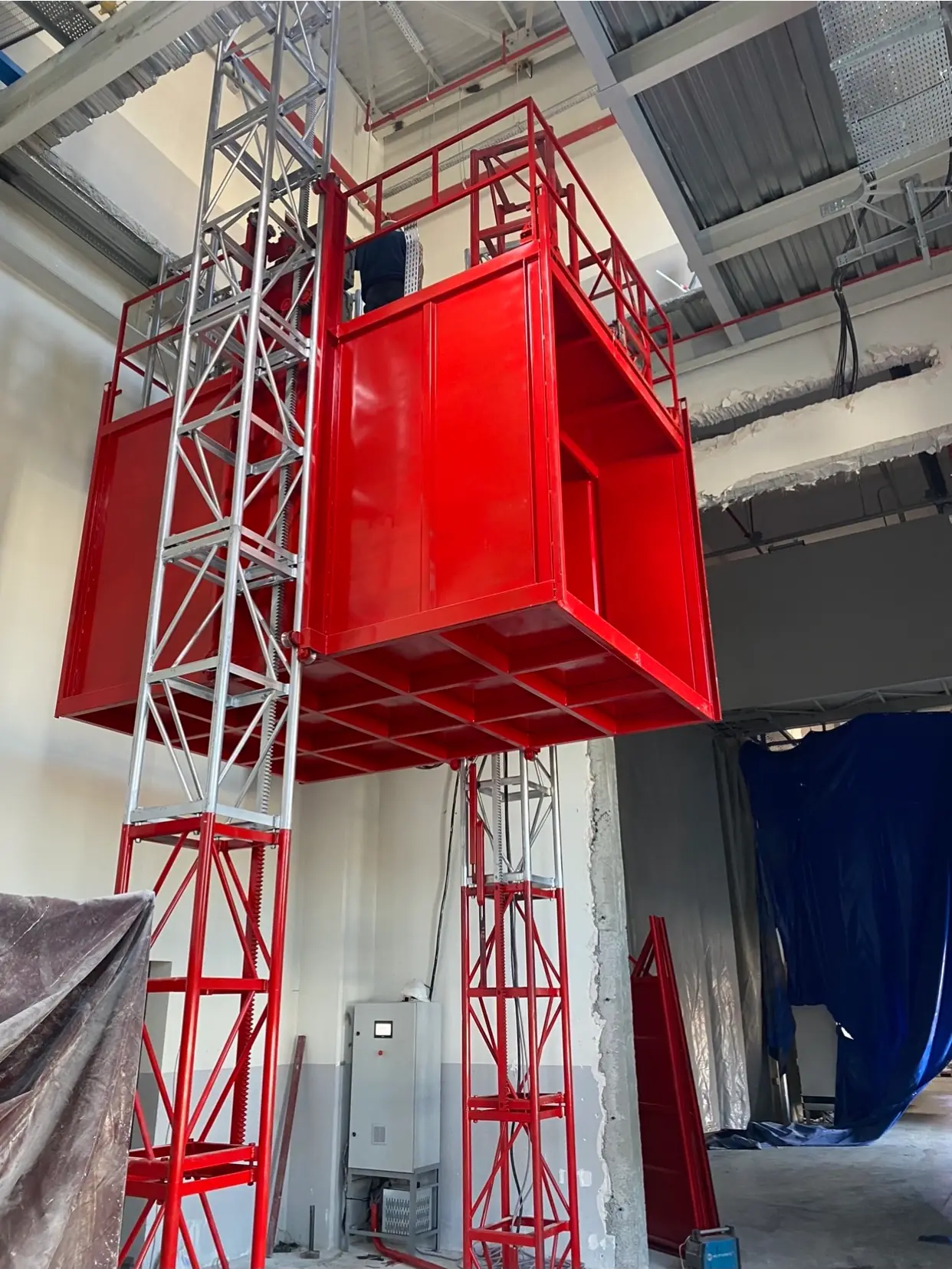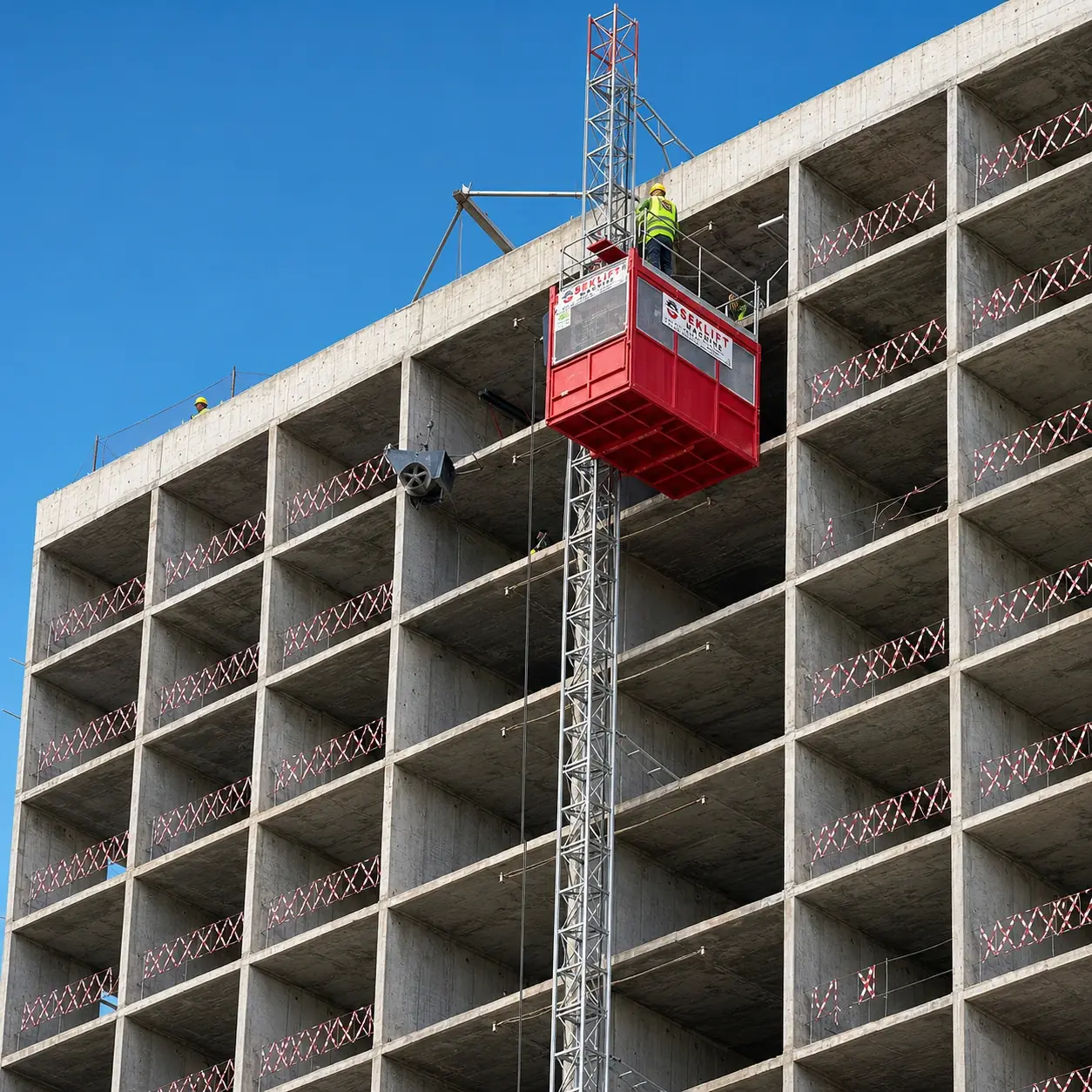
Can a Lighter Load Put More Stress on Parts of a Mast Climber Than a Heavier One?
Mast climber load distribution: why rated capacity alone doesn't tell the whole story.
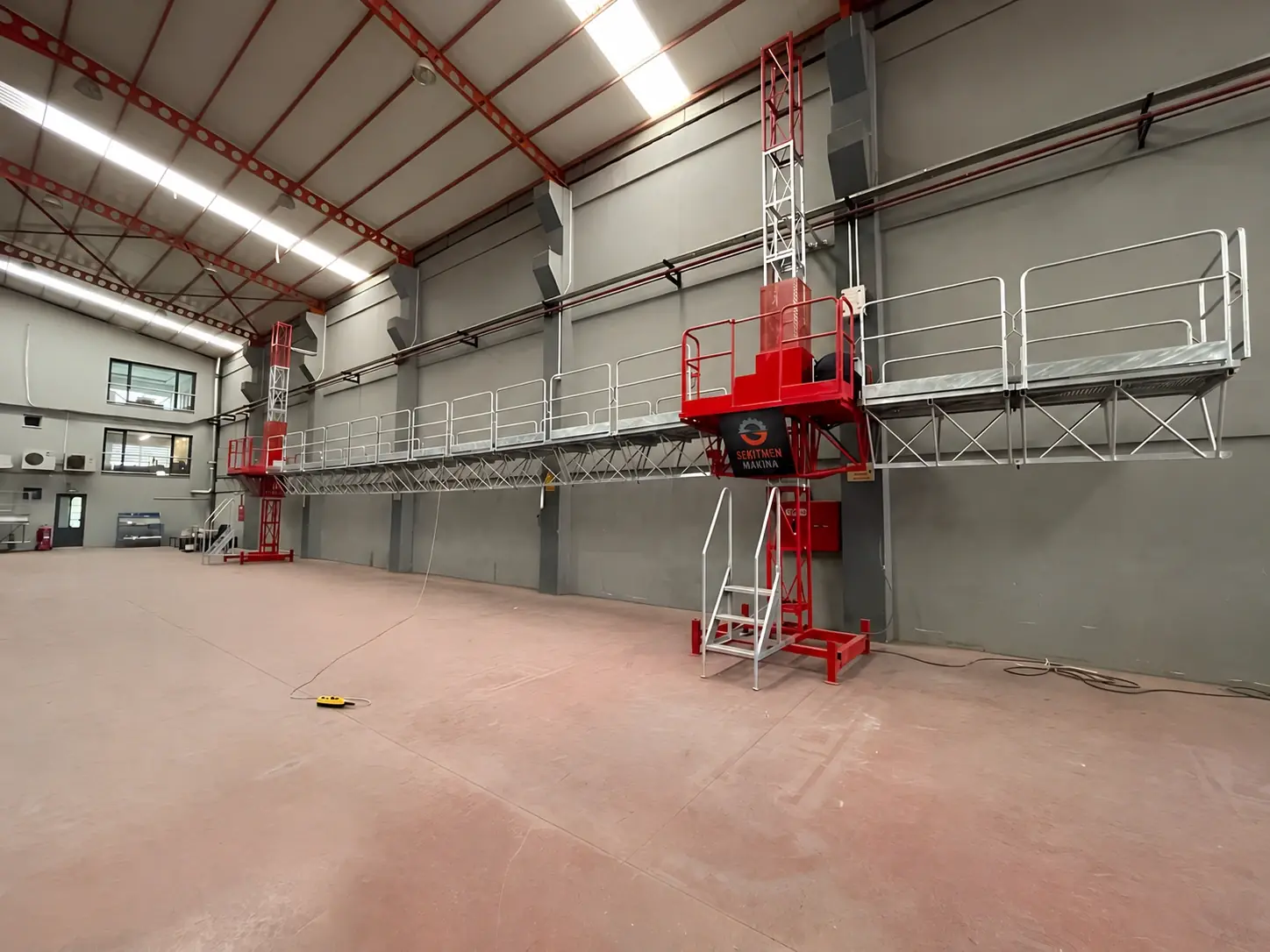
MCWP design standards require engineers to consider cases in which a reduced but unfavorably distributed load can produce higher stresses in some parts of a mast-climbing work platform than a balanced rated-load case.
Separately, recent physical testing has shown that a lower-total-mass but asymmetrically positioned loading condition can produce a higher local anchorage reaction than heavier but differently distributed loading conditions.
These are related ideas, but they are not the same measurement.
They also do no mean that lighter loads are generally more dangerous, or that reducing total mass itself causes structural forces to rise.
The engineering point is more precise:
Total weight alone does not completely describe how a mast-climbing work platform is loaded.
Load position, platform geometry, mast arrangement, operating height, anchorage configuration, support conditions and dynamic movement can all affect how forces are transmitted through the system.
ISO 16369:2007 requires designers to consider unfavorable loading combinations and specifically provides for the possibility that a reduced unbalanced loading case can create higher stresses in some components than a balanced rated-load condition. Its structural calculations also distinguish between single- and multiple-mast arrangements.
What Does “Rated Capacity” Actually Mean on a Mast Climber?
It is tempting to read a specification such as 2,000 kg capacity as a simple rule:
If the people, tools and materials on the platform weigh less than 2,000 kg, the loading condition must be acceptable.
MCWP engineering is more complicated than that.
ISO 16369 treats rated load within a defined machine configuration and load-distribution framework. Its structural provisions require the loads and forces that can occur in permitted configurations to be considered, including combinations capable of producing unfavorable component stresses.
This is also how practical guidance treats the issue.
IPAF's MCWP load-chart guidance tells users to understand the applicable load restrictions and explicitly states that its generic chart does not replace the manufacturer's instruction manual for the actual load capacities and configurations.
NIOSH likewise emphasizes that MCWP configurations and setups are site-specific and that manufacturer specifications and instructions should be consulted for the actual arrangement being used.
So the correct interpretation is not:
“The platform is rated for X kilograms, therefore X kilograms may be placed anywhere.”
It is closer to:
“The platform is designed for its rated loading within defined configurations and permitted loading arrangements.”
Being below a headline capacity therefore does not, by itself, establish that every possible placement of the load is permitted.
Same Kilograms, Different Forces: Why Load Position Matters
The basic mechanical idea can be understood without turning this into a structural-design textbook.
One useful concept is bending moment, which can be expressed conceptually as:
Moment ≈ Force × Distance
Suppose the weight of a material load stays exactly the same but moves farther away from a structural support.
Its mass has not increased.
Its leverage has.
That can change the bending demand carried by parts of the structure.
A real mast-climbing platform is far more complex than a simple lever. Forces pass through the working deck, drive structure, mast or masts, connections, base and—on tied installations—the anchorage system.
Moving material can therefore change the load path through the complete structure rather than merely changing one isolated force.
This is why the standards require designers to consider unfavorable load positions.
ISO 16369:2007 Clause 5.1.2.2.3 assumes eccentric material loading on the side producing the highest stresses and requires calculations to allow for the possibility that a reduced unbalanced condition creates higher stresses in some parts than the balanced rated-load case. The same clause uses different longitudinal bending formulations for single-mast and multiple-mast machines and accounts for load concentration.
EN 1495:1997+A2:2009 Clause 5.1.2.2.3 contains the corresponding European design treatment for eccentric loading, reduced unbalanced cases, concentrated loading and different single-/multiple-mast bending calculations.
What they establish is the engineering requirement to evaluate unfavorable load distributions rather than relying only on total kilograms.
That gives us a strong conclusion:
Total load and load position are different engineering variables.
Can a Lighter Load Really Produce a Higher Reaction? The 2026 Experiment
In 2026, Xu and colleagues published an instrumented physical study investigating reaction forces at MCWP anchorages. (Xu et al., 2026)
The researchers used a single-mast ACT-8 MCWP in a simulated work-site arrangement. Two mast anchorages were instrumented using strain gauges, and platform motion was measured with accelerometers.
The experiment varied:
- added load,
- load distribution,
- and the vertical position of the platform.
Xu et al. tested the stationary platform at six heights:
P1 = 2.3 m, P2 = 3.3 m, P3 = 4.3 m, P4 = 6.8 m, P5 = 7.8 m and P6 = 8.8 m.
The three engineers and measurement equipment weighed approximately 650 lb in total. Added steel-block conditions included 990 lb y 1,980 lb, each arranged using defined distributions.
One comparison is particularly useful for understanding why total mass alone cannot describe the reaction at a particular structural location.
At P3, 4.3 m above ground, Xu et al.'s Table 3 reports the following relative static reaction at the first instrumented anchorage:
| Added-load condition | Relative static reaction at Anchorage 1 |
|---|---|
| 990 lb, left-front placement | 1.64 kN |
| 1,980 lb, distributed over both sides | 1.28 kN |
| 1,980 lb, front areas of both sides | 1.31 kN |
In that specific tested condition, the lower-total-mass, asymmetrically positioned 990 lb configuration produced a higher measured local anchorage reaction than either of the two tested 1,980 lb configurations.
That is the most important physical observation in this article.
But it needs to be interpreted carefully.
The experiment therefore does no establish that reducing mass caused the anchorage reaction to increase.
Instead, it demonstrates that load magnitude, load placement and the resulting structural load path can interact.
There is another equally important measurement boundary:
Xu et al. measured anchorage reaction forces and platform accelerations.
They did not directly measure global structural stress throughout the whole MCWP.
The experiment does not tell us that every mast section, platform member, connection, drive structure or base component experienced greater stress in the 990 lb condition.
The supportable conclusion is narrower:
A lower-total-mass but asymmetrically positioned configuration produced a higher measured local anchorage reaction than heavier but differently distributed configurations under that particular tested condition.
Important experimental limitations
The stationary experiment used two trials per treatment at each tested platform position, with each trial lasting approximately 20–40 seconds. The numerical values are therefore configuration-specific experimental observations rather than population estimates of MCWP behavior.
The experiment was also far below destructive loading.
The maximum added test load of 1,980 lb was less than 20% of the ACT-8 platform's stated 10,000 lb allowable maximum, and the authors report that operation under the investigated conditions remained within a safe range.
Temperature was another limitation. The strain-gauge system experienced temperature-related baseline effects, restricting the reliability of long-duration absolute static-force interpretation. The researchers therefore relied substantially on relative changes and short-duration responses.
The physical setup itself should also not be mistaken for every building installation.
Three single-mast ACT-8 systems with freestanding bases were used. One was the test machine, while two others were connected by steel beams to act as the attachment structure for the instrumented anchorages. This represented a simulated work-site support arrangement, not every real construction anchorage condition.
In addition, the authors state that the forces on all instrumented anchorages and platform accelerations were not recorded simultaneously for every treatment, and they identify fully simultaneous measurement as an improvement for future studies. They also recommend future field testing using actual construction anchorage attachments and higher loading levels.
So the Xu experiment is valuable precisely for what it directly measures:
configuration-specific anchorage-reaction behavior.
It is not a universal MCWP load-limit experiment.
Why Platform Height and Anchorage Configuration Matter
Load placement was not the only variable investigated.
Xu et al. found that platform position could influence measured anchorage reactions in their experimental system.
But the results were not uniform across the anchorages.
This matters because it prevents us from replacing one oversimplification with another.
The research does no justify a rule such as:
“The higher the platform goes, the greater every anchorage reaction becomes.”
In fact, Xu et al. reported that forces at the second anchorage were not substantially affected by platform height and loading conditions in the same way predicted by the earlier numerical model.
The authors proposed several reasons for this non-confirming behavior:
- their experimental mast was shorter than the system used in the earlier FEM work,
- the applied experimental loads were substantially lower,
- and the physical attachment structure was flexible whereas the previous numerical model assumed a rigid attachment.
They also observed asymmetry in measured anchorage-arm forces that was not predicted by the model, possibly reflecting real structural and connection asymmetry that the model simplified.
That is an important result.
It demonstrates why numerical models and physical experiments should not be treated as interchangeable evidence.
Earlier work by Wu and colleagues used finite-element analysis to examine a representative MCWP operating at different heights and under different loading conditions. Their models indicated that anchorage reaction forces and moments were sensitive to loading and operating conditions and explored mast response after simulated loss of one anchorage. (Wu et al., 2023)
Wu et al.'s results are useful numerical engineering evidence.
But numerical results depend on geometry, material properties, connection assumptions and boundary conditions.
Xu et al.'s later experiment provides direct physical measurements, while simultaneously showing where simplified model assumptions may not reproduce the exact physical response.
Neither source should be used to derive a universal numerical relationship between platform height and anchorage force.
Independent Evidence: Why Geometry Limits Generalization
A major limitation of the MCWP research base is that several important papers involve overlapping NIOSH researchers.
Independent work is therefore useful—not because every new paper must reproduce the exact same result, but because it can test whether broader principles survive different equipment arrangements.
Ni, Zhang and Li published an independent 2024 case study concerning façade renovation of a high-rise building using linear and L-shaped twin-column MCWP configurations. (Ni, Zhang & Li, 2024)
Their work included finite-element modeling of the project-specific MCWP arrangements.
The study does no replicate Xu's 990 lb versus 1,980 lb anchorage comparison.
It addresses a different question.
Its value here is that the researchers explicitly treated the L-shaped twin-column geometry as requiring configuration-specific structural analysis instead of assuming conclusions from earlier single-column MCWP research could simply be transferred to the new arrangement.
That independently supports a broader methodological conclusion:
MCWP structural response is configuration-dependent.
Platform length and geometry, mast arrangement and spacing, anchorage layout, base conditions, operating height, boundary conditions and load placement can all alter the structural load path.
Numerical values measured or modeled for one machine arrangement should therefore not be transferred directly to another MCWP configuration without appropriate engineering justification.
Static Weight Is Only Part of the Load
There is another reason kilograms alone do not completely describe MCWP structural demand.
A working machine moves.
Workers move across the deck.
The elevating mechanism accelerates and decelerates.
The structure vibrates.
ISO 16369 distinguishes static and dynamic structural-load conditions and requires applicable load combinations to be considered during design.
Xu et al. also measured dynamic anchorage reactions and platform acceleration.
They found measurable dynamic components associated with worker activity and platform starting and stopping, with the dynamic anchorage forces correlated with platform vibration.
In some tests, dynamic reaction components exceeded 3 kN. The researchers discussed repeated dynamic forces superimposed on static loading as potentially relevant to anchorage fatigue and suggested that reducing abrupt starting and stopping could reduce peak dynamic reactions and repeated vibration cycles.
This should not be rewritten as:
“Starting and stopping damages MCWP anchorages.”
The experiment did not measure fatigue life or demonstrate fatigue failure.
Its contribution is narrower:
The structural loading of an operating MCWP is not completely described by the stationary mass on the deck.
Dynamic loading also does not automatically imply instability.
Wimer et al. 2017 provides useful supporting physical evidence on this point. (Wimer et al., 2017)
The researchers tested one properly erected freestanding ACT-8 MCWP under simulated fall-arrest impacts. Under their tested conditions, destabilizing forces were small and they observed no indication of impending MCWP collapse.
That experiment did not examine the lighter-load/load-position question.
Its role here is contextual:
dynamic response and stability depend on the tested machine configuration and loading event.
Single Mast vs Twin Mast: Different Load Paths, Not a Simple Strength Ranking
Mast count is another specification that can easily be oversimplified.
A single-mast MCWP and a twin-mast MCWP are not simply identical platforms with one or two towers underneath them.
ISO 16369 applies to systems with one or more masts and uses different bending formulations for single-mast and multiple-mast machines under Clause 5.1.2.2.3.
EN 1495 uses the corresponding distinction within its structural calculations.
The independent Ni, Zhang and Li study reinforces the need for this configuration-specific treatment by analyzing different twin-column geometries rather than assuming single-column results would automatically transfer.
The defensible conclusion is therefore:
Single-mast and multiple-mast MCWPs have different structural arrangements and load paths.
What cannot be concluded from mast count alone is that a twin-mast machine is automatically:
- twice as strong,
- twice the capacity,
- safer,
- or structurally superior.
Capacity belongs to the complete engineered configuration.
What Does This Mean on an Actual Jobsite?
For contractors and site engineers, the practical lesson is not that capacity figures are unreliable.
It is that they require context.
The relevant configuration can include:
- platform geometry,
- mast arrangement and spacing,
- personnel,
- tools and materials,
- material position,
- operating height,
- base conditions,
- anchorage arrangement,
- and the manufacturer's approved configuration.
NIOSH treats MCWP installations as configuration- and site-specific.
IPAF likewise states that generic MCWP loading guidance does not replace the manufacturer's information for the actual machine configuration.
These organizations provide practical safety and equipment-use guidance.
They are not experimental structural studies.
The useful project question is therefore not only:
“How many kilograms can this mast climber carry?”
It is also:
“How may that load be arranged in this particular configuration?”
This article cannot answer the second question for an individual installation.
What the SEKLIFT Range Shows About Configuration
SEKLIFT's current mast-climbing platform range provides a useful product illustration of why machine architecture and headline capacity should not be reduced to a simple “number of masts = capacity” rule.
The current English MCWP page publishes the following specifications as of 8 October 2026:
| Modelo | Mast arrangement | Published load figure | Published platform geometry |
|---|---|---|---|
| SM-SK-101 | Un mástil | 2.000 kg | 4.2–10 m platform; 135 m standard height; project configurations evaluated up to 300 m |
| SM-SK-102 | Dos mástiles | Hasta 2.000 kg | Up to 30 m working width; up to 200 m lifting height |
| SM-SK-103 | Compact twin mast | 750 kg con 11,5 m | Up to 11.5 m platform; up to 40 m height |
SEKLIFT's current page also tells buyers to consider working height, people, tools, material distribution and the available base and tie interfaces, and specifically warns against combining maximum published figures into an assumed operating configuration without technical confirmation.
These figures support one limited observation:
mast count alone does not determine published capacity.
They do no prove:
- load redistribution behavior,
- anchorage reaction behavior,
- the Xu experimental finding,
- the ISO or EN design requirements,
- or any general rule about lighter loads.
They also do not establish where a given material load may be positioned on an installed SEKLIFT platform.
That requires the approved load diagram and project-specific technical documentation.
So, Can a Lighter Load Put More Stress on Parts of a Mast Climber?
The answer has three levels.
What is strongly established by the design requirements
Rated loading cannot sensibly be interpreted without considering load distribution and configuration.
ISO 16369 and EN 1495 require designers to consider unfavorable eccentric and unbalanced load cases, including circumstances in which reduced loading can govern the stress in particular components.
What has been directly observed, but only in one configuration
Xu et al. physically measured a higher local anchorage reaction under one lower-total-mass asymmetric loading configuration than under two heavier but differently distributed configurations at one tested platform height.
That result is configuration-specific.
It does not demonstrate that lower mass itself caused the higher reaction.
What has not been established universally
The literature does not provide a universal percentage relationship between:
- load position and anchorage reaction,
- platform height and anchorage reaction,
- or total load and local structural response across different MCWP designs.
Nor does it establish that lighter loads are generally more dangerous.
So the final engineering lesson remains simple:
Rated capacity remains essential, but it must be interpreted together with load distribution and the complete engineered configuration.
Total load and load position are different engineering questions.
Methodology and Evidence Note
This article is a targeted engineering narrative review, not a systematic review or meta-analysis. A final literature-update and contradiction search was performed on 8 October 2026. PubMed was searched as a bibliographic database for MCWP-specific records. Publisher platforms and journal sources checked included Elsevier/ScienceDirect, MDPI, ASCE Library and the Civil Engineering Journal/OJS platform; relevant World Scientific article metadata was cross-checked through DOI and repository records. Official sources included ISO and BSI for standards status and NIOSH/CDC and IPAF for safety and industry guidance.
Representative search concepts included mast climbing work platform structural analysis, MCWP eccentric load, mast climber load distribution, MCWP anchorage reaction, mast climbing platform finite element, MCWP structural stability, MCWP dynamic reaction, mast climbing work platform load position, MCWP unbalanced load, EN 1495 unbalanced load, y ISO 16369 load diagram. Searches were also deliberately framed to find different mast geometries, alternative boundary conditions, independent research groups and contradictory or non-confirming results. Targeted backward/reference checking was performed around the principal MCWP studies, but no exhaustive citation-screening protocol was used.
Priority was given to MCWP-specific physical studies, numerical analyses, directly applicable standards and peer-reviewed review literature. Generic aerial-platform research, marketing material, unsupported trade commentary and sources mentioning MCWPs only tangentially were deprioritized. Evidence was qualitatively appraised for directness, study design, measurement type, replication, configuration specificity, external validity, research-group independence and the role of the source. No formal risk-of-bias scoring instrument was applied because this was a targeted engineering narrative review rather than a systematic evidence synthesis.
The article uses a source-role framework rather than a single evidence hierarchy: standards define required design treatment; Xu provides direct physical measurements; Wu and Ni provide configuration-dependent numerical evidence; Wimer provides supporting stability testing; Dong et al. provides review context; NIOSH/IPAF provide practical guidance; and SEKLIFT data is used only for product illustration. Xu 2026, Wu 2023, Wimer 2017 and Dong 2025 involve overlapping NIOSH researchers and related research activity, so they are treated as complementary rather than fully independent confirmations. Ni et al. 2024 is independently authored and supports configuration dependence, but it does not independently replicate Xu's lighter-load anchorage observation.
A targeted search for directly contradictory MCWP-specific peer-reviewed evidence did not identify a study that overturned the central load-distribution principle. However, Xu's own physical results did not reproduce every response predicted by the earlier FEM model, reinforcing the limits of generalizing across boundary conditions and configurations.
Standards status checked 8 October 2026. ISO lists ISO 16369:2007, Edition 2 as the current published edition, last reviewed and confirmed in 2022. BSI lists BS EN 1495:1997+A2:2009 as Current, Under Review, and BSI's standards-development system shows an active BS EN 1495 revision project. These standards are treated here as engineering references; their legal applicability depends on jurisdiction.
Preguntas frecuentes
Can a mast climber be improperly loaded even if it is below its rated capacity?
Yes. Being below the headline capacity does not establish that every load placement is permitted. MCWP standards require unfavorable loading arrangements to be considered during design, while the manufacturer's load information governs the actual installed configuration.
Does load position really matter on a mast-climbing work platform?
Yes. ISO 16369 and EN 1495 require eccentric, concentrated and unfavorable load cases to be considered. Xu et al. also physically measured different local anchorage reactions under different combinations of loading amount, position and platform height.
Can a lighter load create more stress than a heavier load?
The standards require designers to consider the possibility that a reduced unbalanced load produces greater stress in some components than a balanced rated-load case. In Xu's experiment, a lower-total-mass asymmetric configuration also produced a higher local anchorage reaction than two heavier tested configurations at one platform position. Because total mass and distribution both changed, the experiment does not show that reducing mass itself caused the higher reaction.
Does mast-climber height affect anchorage reactions?
It can, but the relationship is configuration-specific. Xu measured height-related effects at one anchorage while the second anchorage did not follow the earlier FEM prediction in the same way. Differences in test geometry, load level and attachment stiffness were among the explanations identified by the researchers.
Is a twin-mast platform automatically stronger than a single-mast platform?
No. The standards use different structural treatment for single- and multiple-mast configurations, but they do not establish a universal strength ranking based only on mast count. Capacity depends on the complete engineered arrangement.
Where should the correct loading limits for a mast climber be found?
In the manufacturer's approved load diagram, operating instructions and technical documentation for the actual installed configuration, together with applicable project and jurisdictional requirements. IPAF explicitly states that its generic MCWP load chart does not replace manufacturer instructions.
Share the working height, platform length, crew, tools, material positions and tie interfaces so the SEKLIFT team can confirm the configuration and its approved load diagram.
Explore SEKLIFT mast-climbing work platforms →Referencias
- Xu, X. S., Warren, C. M., White, R. S., Wu, J. Z., Villeneuve, F., Dong, R. G., & Pan, C. S. 2026. Evaluating Dynamic Reaction Forces at Anchorages to Enhance the Safety of Mast Climbing Work Platforms. Buildings, 16(4), 878. DOI: 10.3390/buildings16040878.
- Wu, J. Z., Pan, C. S., Wimer, B. M., Warren, C. M., Villeneuve, F., & Dong, R. G. 2023. A Finite Element Analysis of the Effects of Anchorage Reaction Forces and Moments on Structural Stability of Mast Climbing Work Platforms. Journal of Multiscale Modelling, 14(3), 2350009. DOI: 10.1142/S1756973723500099.
- Ni, Y., Zhang, Y., & Li, P. 2024. Application of L-Shaped Mast Climbing Work Platform (MCWP) in Façade Renovation of High-Rise Buildings: A Case Study. Stavební obzor – Civil Engineering Journal, 33(3), 350–362. DOI: 10.14311/CEJ.2024.03.0024.
- Dong, R. G., Pan, C. S., & Wu, J. Z. 2025. Safety Design, Use, and Research of Mast Climbing Work Platforms. Journal of Construction Engineering and Management, 151(12), 03125009. DOI: 10.1061/JCEMD4.COENG-16369.
- Wimer, B., Pan, C. S., Lutz, T., Hause, M., Warren, C., Dong, R., & Xu, S. 2017. Evaluating the Stability of a Freestanding Mast Climbing Work Platform. Journal of Safety Research, 62, 163–172. DOI: 10.1016/j.jsr.2017.06.014.
- International Organization for Standardization. 2007. ISO 16369:2007 — Elevating Work Platforms — Mast-Climbing Work Platforms. Edition 2. Current published edition; reviewed and confirmed in 2022. Relevant provisions used here include Clause 5.1 structural/stability calculations and Clause 5.1.2.2.3 concerning unfavorable load distribution and single-/multiple-mast bending treatment.
- European Committee for Standardization. 2009. EN 1495:1997+A2:2009 — Lifting Platforms — Mast Climbing Work Platforms, including AC:2010 corrigendum. Relevant provisions include Clause 5.1 and Clause 5.1.2.2.3 concerning eccentric, unbalanced and concentrated loading and single-/multiple-mast structural treatment. BS EN implementation status: Current, Under Review as of 8 October 2026.
- National Institute for Occupational Safety and Health. Mast Climbing Work Platform Safety. Centers for Disease Control and Prevention. Used as configuration-specific practical safety guidance rather than structural experimental evidence.
- International Powered Access Federation. Mast Climbing Work Platform (MCWP) Load Chart. Ref. UKAX 06/10-001. Used as practical load-configuration guidance rather than experimental evidence.