Many hoist commissioning delays come down to electricity, not steel. The supply can be too weak, the cable from the site board too long, the breaker can trip on every start, or the generator can stall when both motors start together. All of these can be avoided if the electrical side is planned at the same time as the foundation.
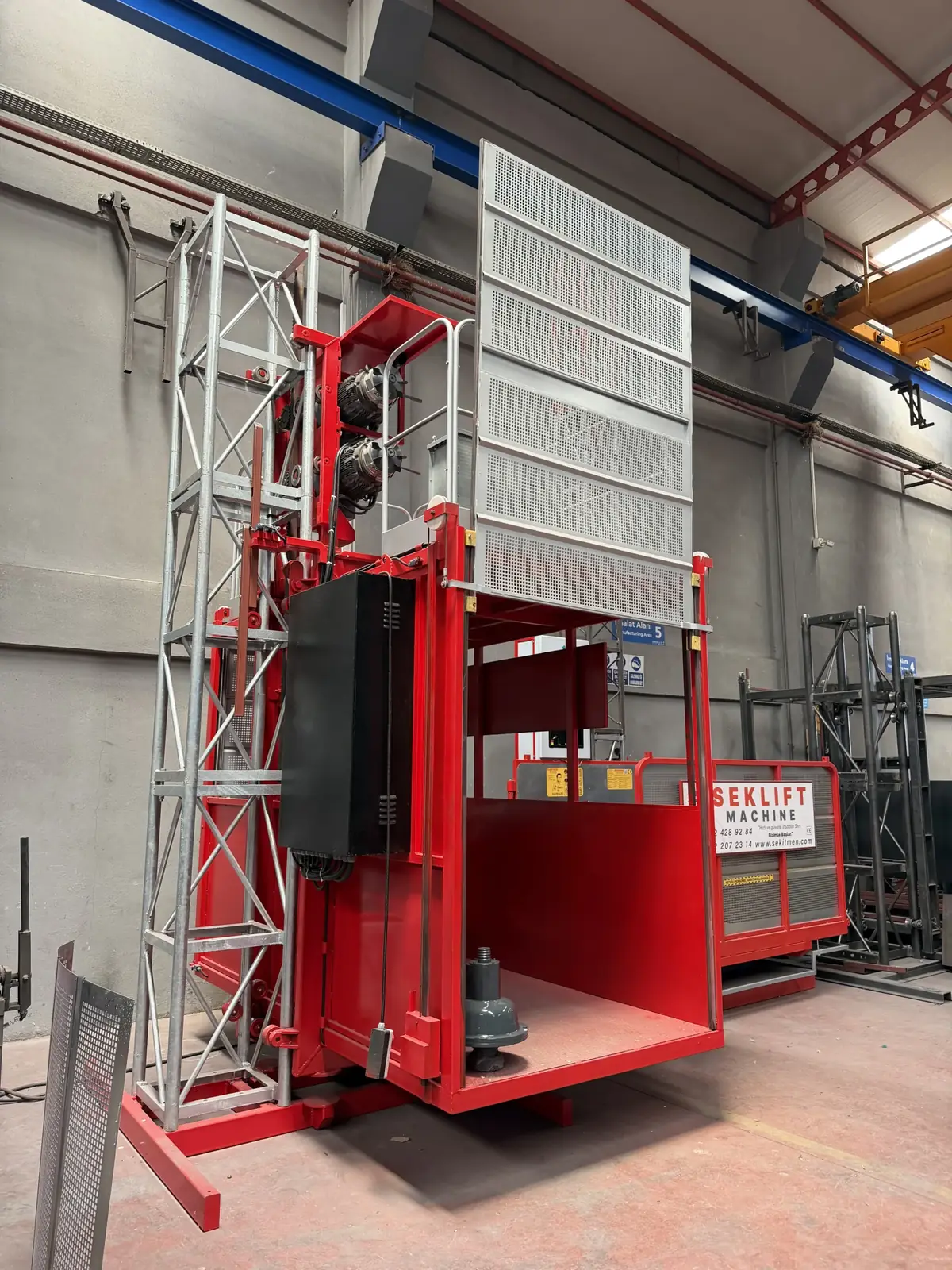
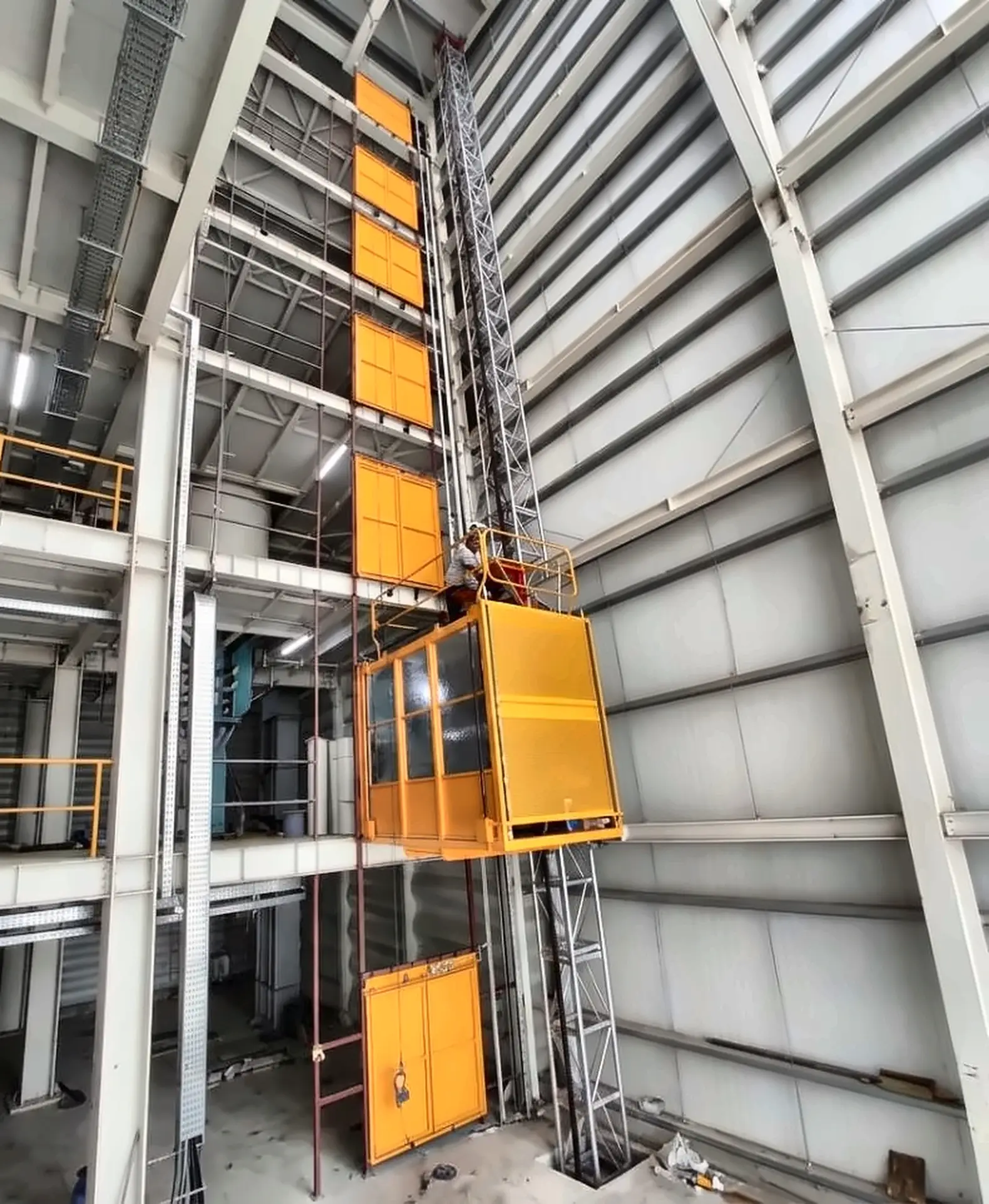
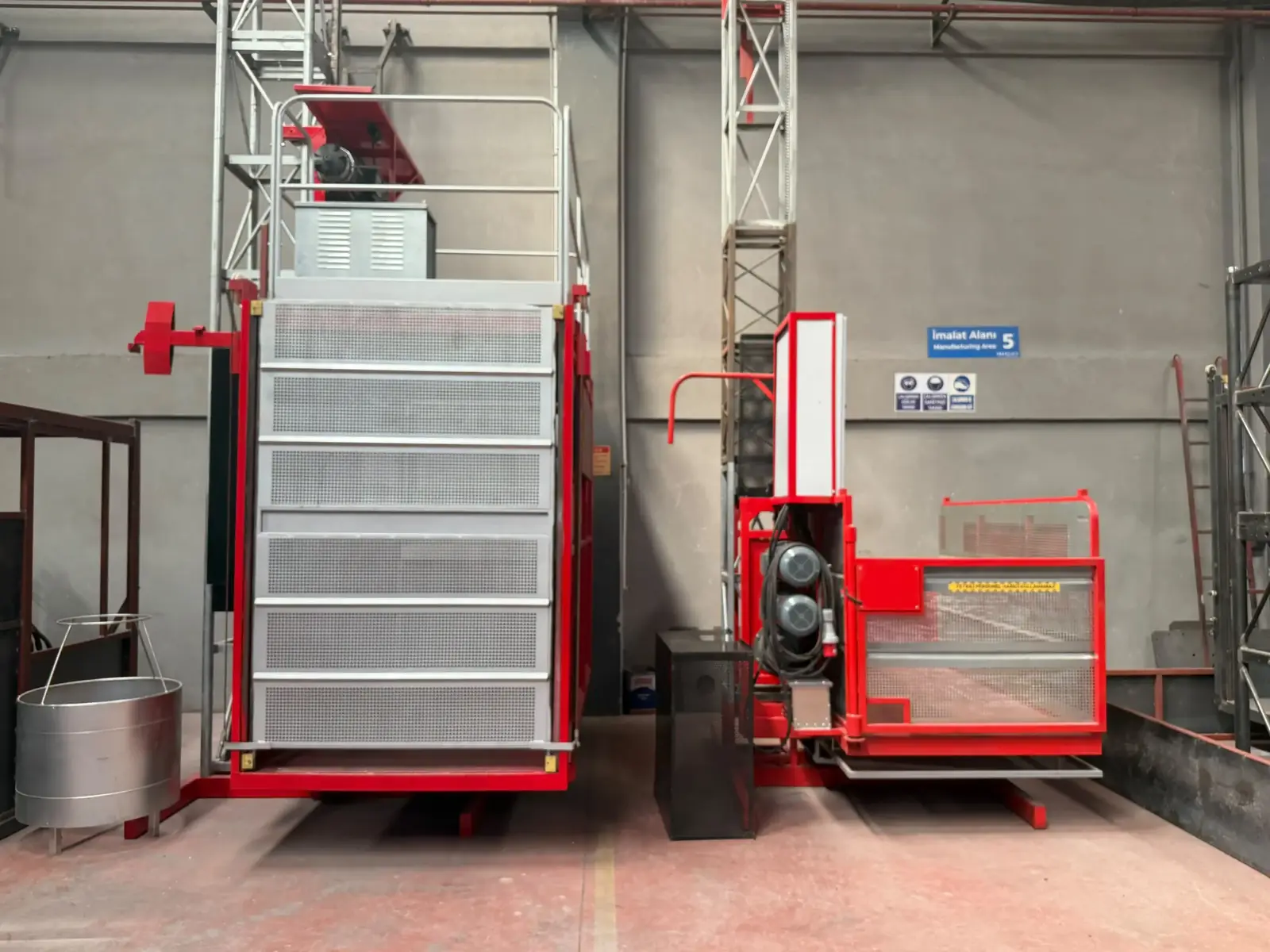
This guide explains what a rack-and-pinion construction hoist needs from the site supply. We use the published data for our SM-GTP-101 Personnel & Material Hoist, plus worked figures that your site electrician can check and refine.
SM-GTP-101 electrical data
Supply: 3-phase + N + PE, 380–400 V, 50 Hz · Drive: 2 × 7.5 kW geared motors (15 kW installed) · Brakes: electromagnetic, one per motor · Option: soft start / soft stop (frequency inverter)
Electrical equipment designed to EN 60204-1 and EN 60204-32.
What the site must provide
From the SM-GTP-101 site requirements:
- A 3-phase supply with neutral and protective earth (3P + N + PE), 380–400 V, 50 Hz.
- A suitably rated circuit breaker at the supply point.
- A dedicated feed to the hoist’s control panel at the mast base, so no shared sockets with site tools and no daisy-chained distribution boards.
Within the hoist’s scope of supply: the electrical control panel, trailing cable and cable guides that take power up the mast to the moving cage.
Running current: an indicative calculation
Motor nameplate power is mechanical output. To estimate the current drawn from the supply, divide by efficiency and use the three-phase power formula:
I = P ÷ (η × √3 × U × cos φ)
Assumptions (typical values for a 7.5 kW, 4-pole industrial motor at full load; replace them with nameplate data): efficiency η ≈ 0.89, power factor cos φ ≈ 0.84.
| Per motor | Both motors (full load) | |
|---|---|---|
| Output power | 7.5 kW | 15 kW |
| Input power (÷ 0.89) | ≈ 8.4 kW | ≈ 16.9 kW |
| Current at 400 V | ≈ 14.5 A | ≈ 29 A |
| Current at 380 V | ≈ 15.2 A | ≈ 30.5 A |
Add a small allowance for the control circuit, brakes and cage lighting. Full-load current only flows when the cage is climbing with a heavy load. Most of a typical working day is spent at part load or standstill.
Starting current: where the problems are
When an induction motor starts direct-on-line (DOL), it briefly draws roughly 6–8 times its rated current. On a twin-motor hoist, both motors start together:
| Start method | Approx. peak current (both motors, 400 V) |
|---|---|
| Direct-on-line | ≈ 175–230 A for a fraction of a second |
| Frequency inverter (soft start option) | ≈ 30–45 A, ramped |
That peak is what:
- trips a breaker with the wrong tripping characteristic;
- causes voltage dips on long feeder cables, which can make contactors chatter or controls reset;
- stalls or overloads a generator sized only for the running load.
The soft start / soft stop option limits the starting current, and it also gives smoother acceleration, gentler stops at landings and less shock load on the rack, gearboxes and wall ties. On weak or generator-fed sites it’s usually the most cost-effective fix.
Cable voltage drop: a worked example
Voltage drop on a three-phase cable can be estimated with:
ΔU = √3 × I × L × (R cos φ + X sin φ)
Example: feeder 50 m long from the site main board to the hoist panel, 4-core 10 mm² copper (R ≈ 2.2 Ω/km at operating temperature, X ≈ 0.08 Ω/km).
| Case | Current | cos φ | Voltage drop | % of 400 V |
|---|---|---|---|---|
| Running, full load | 29 A | 0.84 | ≈ 4.8 V | ≈ 1.2 % |
| DOL start | ≈ 200 A | ≈ 0.40 | ≈ 16.5 V | ≈ 4.1 % |
That’s comfortable on a stiff supply. But voltage drops add up along the whole path: transformer → site board → feeder → hoist panel → trailing cable. A long feeder, an undersized cable or a heavily loaded site transformer can push the starting dip high enough to cause nuisance faults. Your electrician should calculate the full path, including the supply impedance, under the applicable wiring rules (e.g. IEC 60364 / national equivalents).
Example values are illustrative only. They’re not a cable selection.
Protection
- Breaker characteristic: choose a device that tolerates the motor starting peak (for example a motor-starting curve, or an MCCB with adjustable settings), while still protecting the cable.
- Residual-current protection: follow local rules for construction-site supplies. If the hoist uses a frequency inverter, check the residual-current device type with the electrician: inverters can produce residual currents that standard Type AC/A devices don’t detect reliably.
- Earthing: the PE conductor must be continuous to the hoist panel, and the mast and base frame must be bonded as the instructions require. Test the earth before commissioning.
- Phase rotation: check phase sequence at connection. A swapped phase reverses the motor direction relative to the controls. Always follow the commissioning checks in the operating manual.
Running the hoist on a generator
On sites without a grid connection, a generator can power the hoist, but size it for the start, not the run.
| Start method | Rule-of-thumb minimum generator rating (15 kW hoist) |
|---|---|
| Direct-on-line | ≈ 45–50 kVA (about 3 × motor kW) |
| Frequency inverter | ≈ 25–30 kVA, generator suitable for non-linear loads |
Rules of thumb are a starting point. Ask the generator supplier for a motor-starting calculation with the actual hoist data and any other loads on the same set. If cranes, welders or concrete pumps share the generator, size for the combined worst case.
Electrical checklist for your hoist enquiry
- Supply voltage, phases and frequency at the site (50 or 60 Hz)
- Grid or generator; if generator, its rating and other connected loads
- Distance from the supply point to the hoist base
- Local rules for site RCD protection and earthing
- Whether soft start / stop is wanted (recommended for weak supplies and generators)
- Required control features: automatic landing stops, load display, high-speed package
Send your site electrical data with your enquiry → · How a rack-and-pinion hoist works · Construction hoists
Frequently asked questions
What power supply does a construction hoist need?
Most European-specification hoists need a 3-phase supply. The SEKLIFT SM-GTP-101 needs 3-phase + N + PE, 380–400 V, 50 Hz, from a dedicated, suitably rated breaker.
How many amps does a construction hoist draw?
It depends on the motors. For a 2 × 7.5 kW hoist, expect roughly 29 A at 400 V at full load, and a much higher, short peak when starting direct-on-line.
Why does my hoist trip the breaker when it starts?
Usually the starting peak exceeds the breaker’s instantaneous trip setting, or voltage dips on a long feeder upset the controls. The fixes are a correctly selected breaker, a larger or shorter feeder, or a soft-start inverter.
What size generator do I need for a construction hoist?
For a 15 kW hoist starting direct-on-line, a common rule of thumb is about 45–50 kVA. With a soft-start inverter, about 25–30 kVA. Confirm with the generator supplier’s motor-starting calculation.
What does soft start do on a construction hoist?
A frequency inverter ramps the motors up and down. It reduces starting current and voltage dips, gives smoother travel and more accurate stops, and reduces mechanical shock on the drive and mast.
Send us the supply voltage, available breaker size and the hoist configuration you are considering. We will confirm the electrical requirements.
View construction hoist models →Sources
- SEKLIFT, SM-GTP-101 Technical Data Sheet, DS-SM-GTP-101 Rev. 2, 10.2026: drive & power, options, site requirements, scope of supply.
- IEC, IEC 60204-1:2016 Electrical equipment of machines — General requirements.
- IEC, IEC 60204-32:2023 Requirements for hoisting machines.
- Calculation methods: standard three-phase power and voltage-drop formulas. Motor efficiency and power-factor values are typical assumptions, not SEKLIFT nameplate data.