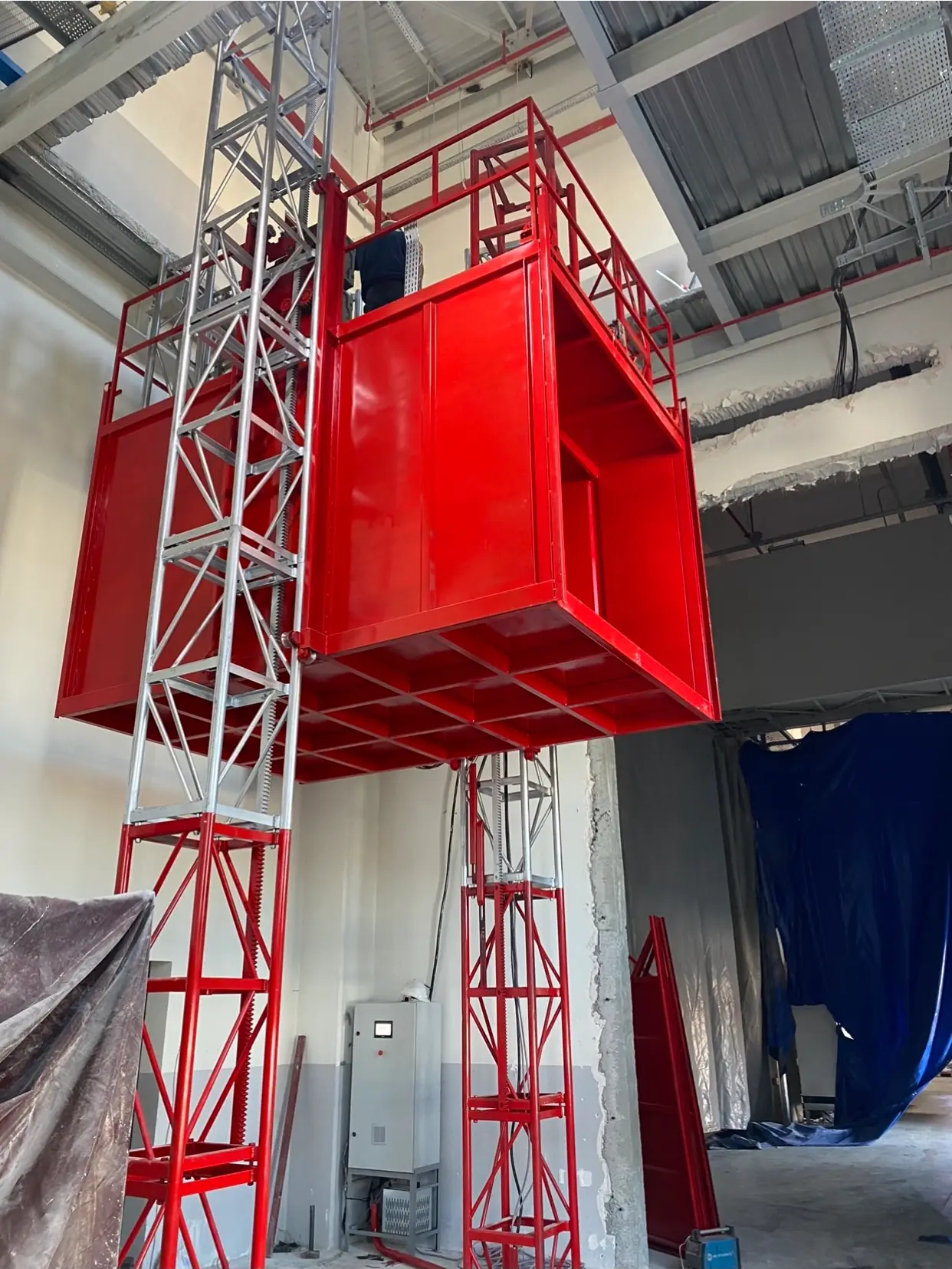
SM-GTP-101 Technical Evidence Note: Documenting a High-Capacity Rack-and-Pinion Construction Hoist
A document-led technical note covering verified SM-GTP-101 specifications, safety equipment, EN 12159 conformity evidence and single- versus dual-cabin selection limits.
Executive summary
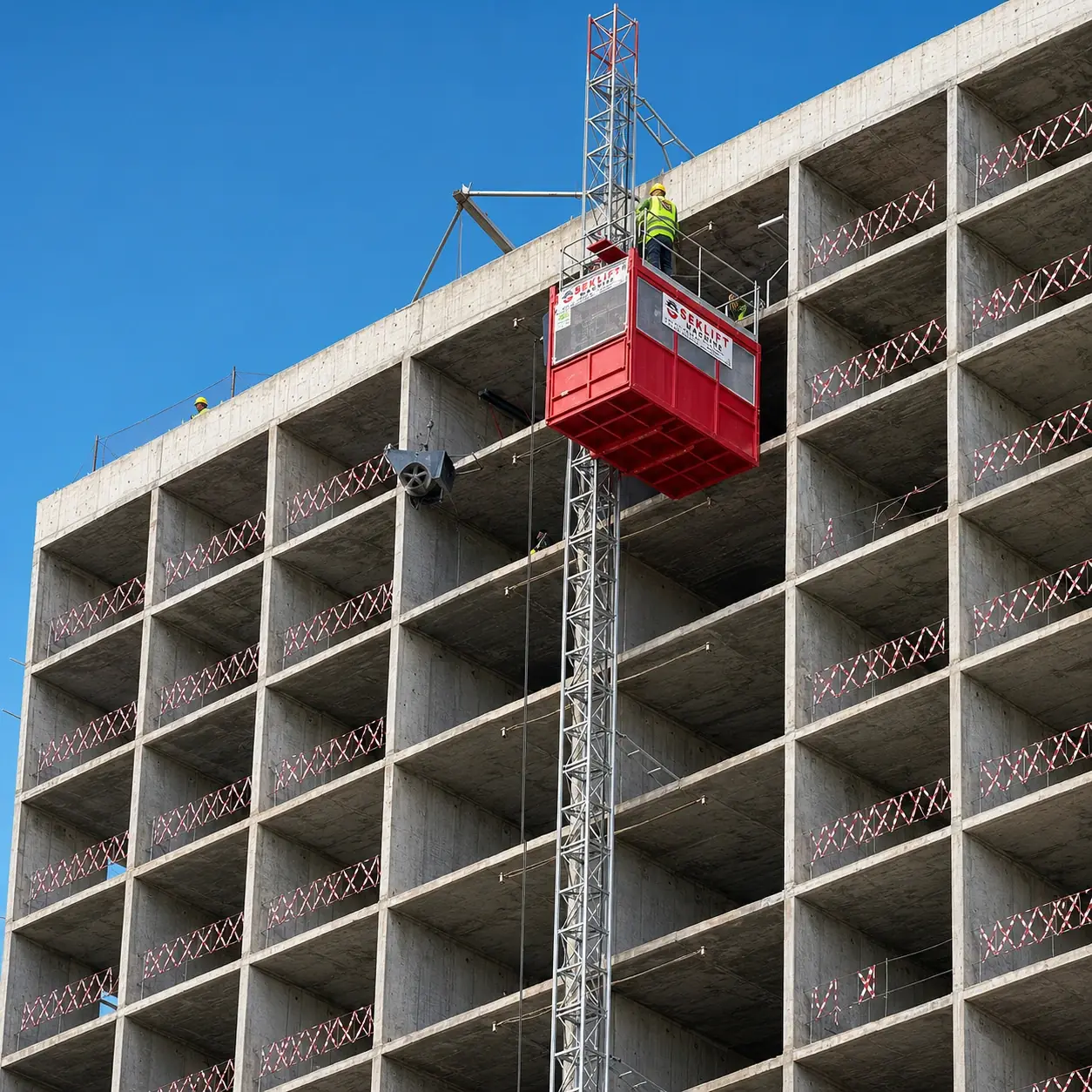
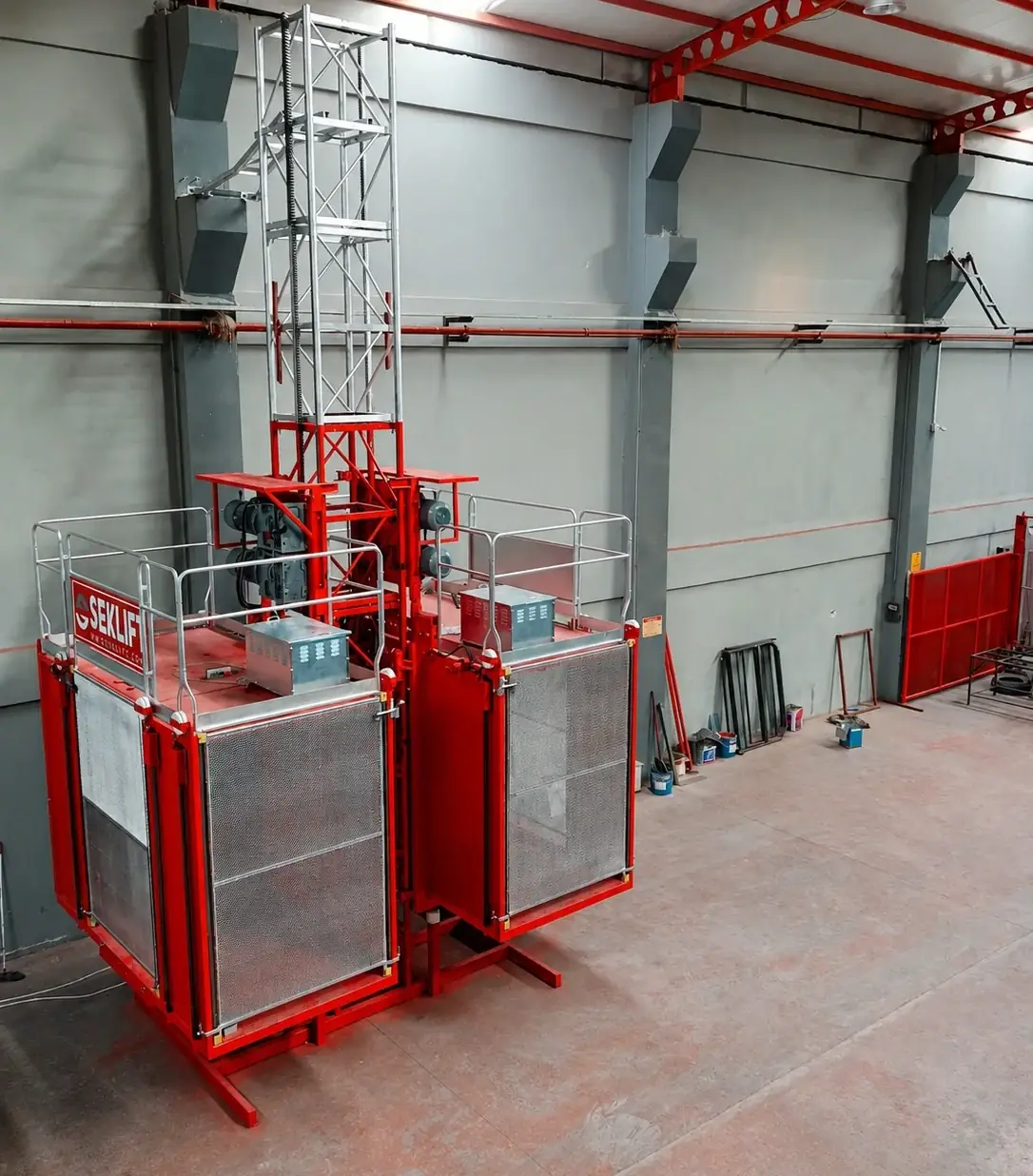
The SM-GTP-101 is a rack-and-pinion construction hoist for temporary personnel and material transport. SEKLIFT's technical file identifies a 2,000 kg single-cabin rated load, a 40 m/min travel speed from a 2 × 7.5 kW twin-motor drive, and a 200 m stated maximum height. A dual-cabin configuration uses two equivalent cabins on one mast, giving a combined rated load of 4,000 kg across the system.Those ratings describe equipment capacity; they do not establish site throughput. Actual transport performance depends on landing count, travel distance, loading discipline, call patterns, door time, power supply, anchoring and other project-specific conditions.
Application context
A personnel-and-material construction hoist is selected around the site transport plan rather than nominal capacity alone. Relevant inputs include peak personnel demand, the dimensions and mass of materials, travel height, landing sequence, cage access, building interface, available power and environmental exposure.The SM-GTP-101 evidence set supports evaluation of a high-capacity temporary vertical-access system. It does not document a named customer installation, a commissioned project result or measured productivity.
Equipment and configuration
| Configuration | Rated load | Personnel rating | Travel speed | Stated maximum height |
|---|---|---|---|---|
| Single cabin | 2,000 kg | Confirmed per configuration | 40 m/min (high-speed option) | 200 m* |
| Dual cabin | 4,000 kg combined 2 × 2,000 kg | Confirmed per configuration | 40 m/min per cabin | 200 m* system |
Single- versus dual-cabin selection
A dual-cabin system may provide additional transport availability and combined rated capacity, but it should not be treated as proof of doubled practical throughput. A useful planning model considers travel time, acceleration and deceleration, loading and unloading, door operation, intermediate stops, call coordination and permitted duty cycles. The choice should therefore be supported by a project traffic study and interface review.
Technical requirements and selection considerations
- Transport demand: peak personnel movements, material loads and time windows.
- Vertical route: travel height, landing count, stopping pattern and anticipated extensions.
- Payload geometry: load dimensions, cage clearances and door-opening needs.
- Structural interface: base conditions, mast ties, façade geometry and anchoring design.
- Electrical supply: voltage, available current, starting demand and site distribution.
- Operating environment: wind, temperature, dust, exposure and local restrictions.
- Compliance: applicable regulations, inspection duties, installation procedure and operator controls.
Verified specifications
| Item | Published SM-GTP-101 data |
|---|---|
| Cage internal dimensions (W × L × H) | 1450 × 2800 × 2200 mm |
| Door opening (W × H) | 1400 × 2100 mm |
| Roof | Guard-railed working platform with escape hatch |
| Mast type | Steel-tube lattice, bolted, with integrated gear rack |
| Mast-section height | 1500 mm |
| Gear rack | Hardened steel rack on every mast section |
| Mast joints | High-strength bolted connections |
| Mast-section weight | ≈ 87 kg |
| Wall-tie spacing | Max. 6 m |
| Ground enclosure | ≈ 3.4 × 2.7 m, interlocked doors |
| Operating wind limits | 72 km/h in service · 45 km/h during erection |
| Ambient temperature | −15 … +55 °C |
Published electrical packages
| Configuration | Motor arrangement | Brakes | Power supply |
|---|---|---|---|
| Standard, 40 m/min | 2 × 7.5 kW | Electromagnetic brake on each motor | 3-phase + N + PE, 380–400 V, 50 Hz |
| High-speed package (option) | Drive and electrical configuration are confirmed for the project. Soft start / soft stop by frequency inverter is available. | ||
Safety architecture
The published equipment data identifies a progressive overspeed safety gear (parachute type), overload monitoring, door interlocking, upper and lower travel limits, emergency lowering provision, spring-applied motor brakes, emergency-stop controls and a 1.10 m ground-station guardrail. This list describes specified safety equipment; it is not a substitute for site risk assessment, correct installation, inspection, maintenance or operator training.
Safety and conformity evidence
| Evidence item | Verified record |
|---|---|
| Document type | EC Type Examination Certificate |
| Certificate number | CAC-M-0001-3 |
| Named model | SM-GTP-101 |
| Equipment description | Builders hoist for persons and materials |
| Referenced standard | EN 12159:2012 |
| Notified body | 2828 |
| Issue date | 30 June 2022 |
| Validity shown on document | 29 June 2027 |
Application lessons
- Use rated load and personnel capacity as boundary conditions, not as a productivity forecast.
- Confirm cage and door geometry against the largest planned loads and landing interfaces.
- Evaluate single- and dual-cabin options using a traffic plan that reflects real stops and handling time.
- Coordinate mast ties, base reactions and power demand before final configuration.
- Read conformity documentation together with the model specification and project obligations.
Limitations and project-specific factors
This note does not verify a customer name, project location, installation date, installed travel height, number of units, cycle time, uptime, downtime, measured productivity, commissioning result or testimonial. It does not replace the manufacturer’s final proposal, engineering calculations, installation manual, local statutory requirements or inspection records. Published specifications should be reconfirmed for the ordered configuration.
SEKLIFT product connection
Review the complete SM-GTP-101 construction hoist specification, compare construction-hoist types and configurations, and inspect the model-specific conformity record. Project-specific selection should be confirmed directly with SEKLIFT engineering.
Compare the full SM-GTP-101 specification and conformity record, then send travel height, landing count, required load, intended passengers or materials, project country and site constraints for a configuration review.
View the SM-GTP-101 specification →Sources and evidence
- SEKLIFT construction-hoist product page — model configuration, dimensions, weights, electrical data, safety systems and real product media.
- SEKLIFT certifications archive — certificate scope and record details.
- Original SM-GTP-101 EC Type Examination Certificate PDF.
- Types of Construction Hoists guide — selection context.