
Types of Construction Hoists: A Practical Guide
Learn the main types of construction hoists, how passenger/material and material-only systems differ, and what to consider when selecting a hoist for a project.
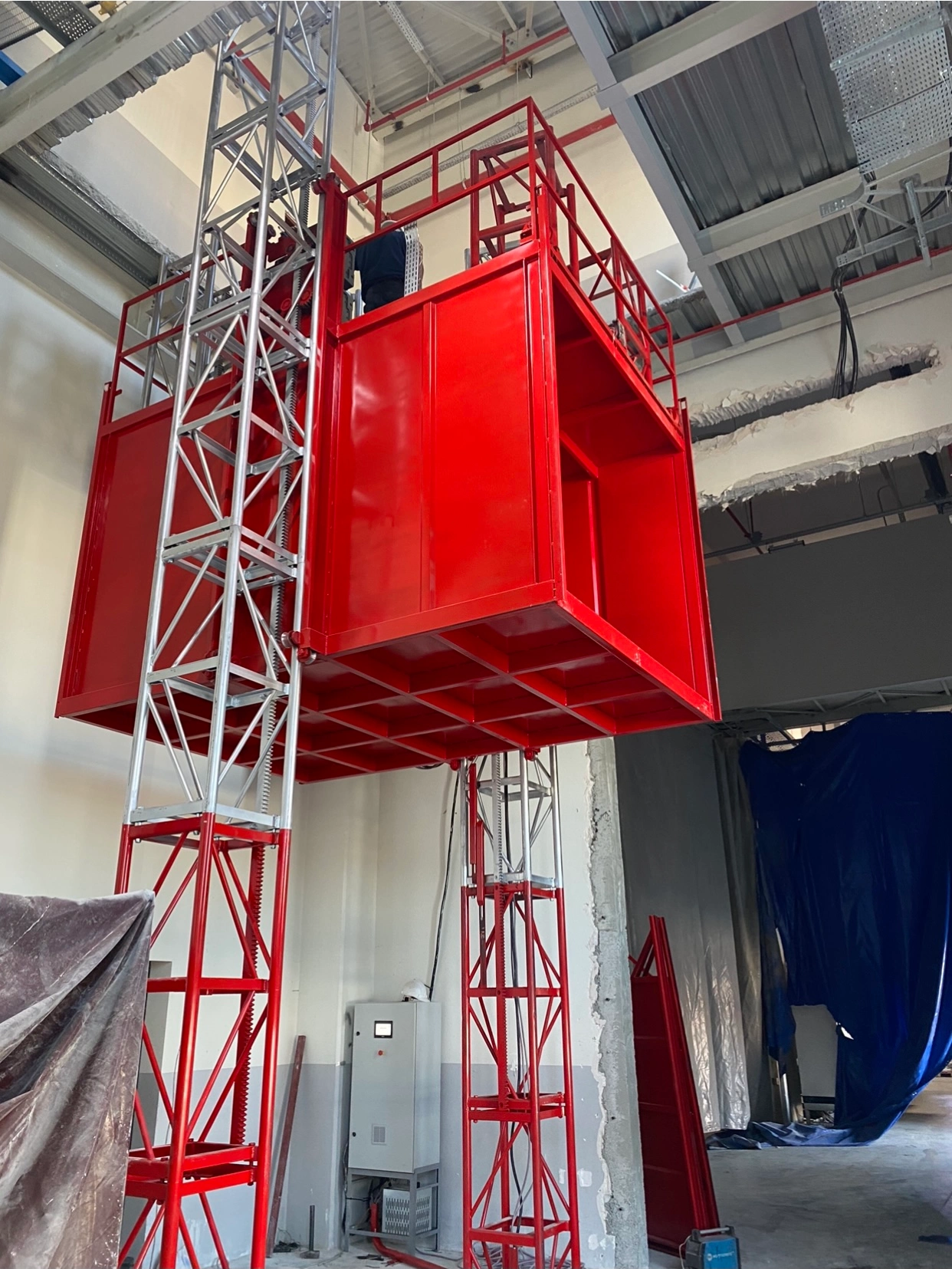
The phrase construction hoist can describe several different lifting systems, which is why online explanations often mix together unrelated equipment. A small chain hoist, a temporary goods hoist and an external passenger/material construction elevator may all be called “hoists,” but they solve very different problems.
For contractors choosing a vertical-access system for a multi-storey project, the useful distinction is not simply “hydraulic, rope or rail.” The better starting point is what the machine is allowed to carry, how it travels, how the landings are arranged and how intensively it will be used.
What is a construction hoist?
A construction hoist is temporary or project-specific vertical-access equipment used to move people, materials or both between levels of a construction site. Depending on the configuration, it may run externally on a mast, within a temporary hoistway, or as a transport platform.
Regulators also distinguish between equipment intended only for goods and equipment approved to carry people. The UK Health and Safety Executive, for example, states that construction hoists should be clearly marked for either goods only or passengers in addition to goods, together with their safe working load and permitted number of persons.
Main types of construction hoists
1. Passenger and material construction hoists
These systems are designed and rated to move workers and construction materials. On high-rise and large commercial projects, they can reduce the time spent moving crews, tools and supplies between floors.
Typical safety architecture includes controlled landing access, car doors or gates, stopping devices, an emergency stop and a rated-capacity plate. Exact requirements depend on the applicable standard, jurisdiction and manufacturer.
2. Material-only construction hoists
Material hoists are intended for equipment and goods rather than passenger transport. They are useful when the main requirement is moving pallets, tools, components or bulk materials between work levels.
A critical operating rule is simple: do not carry passengers on a goods-only hoist. The HSE explicitly warns against this, and OSHA applies separate requirements to material and personnel hoists.
3. Transport platforms
Transport platforms provide a working deck or platform that travels vertically along a mast system. Their permitted use, speed and passenger rules depend on the machine classification and local regulations. They can be attractive when projects need a flexible loading area rather than a fully enclosed passenger-hoist cabin.
4. Single-cage and twin-cage hoists
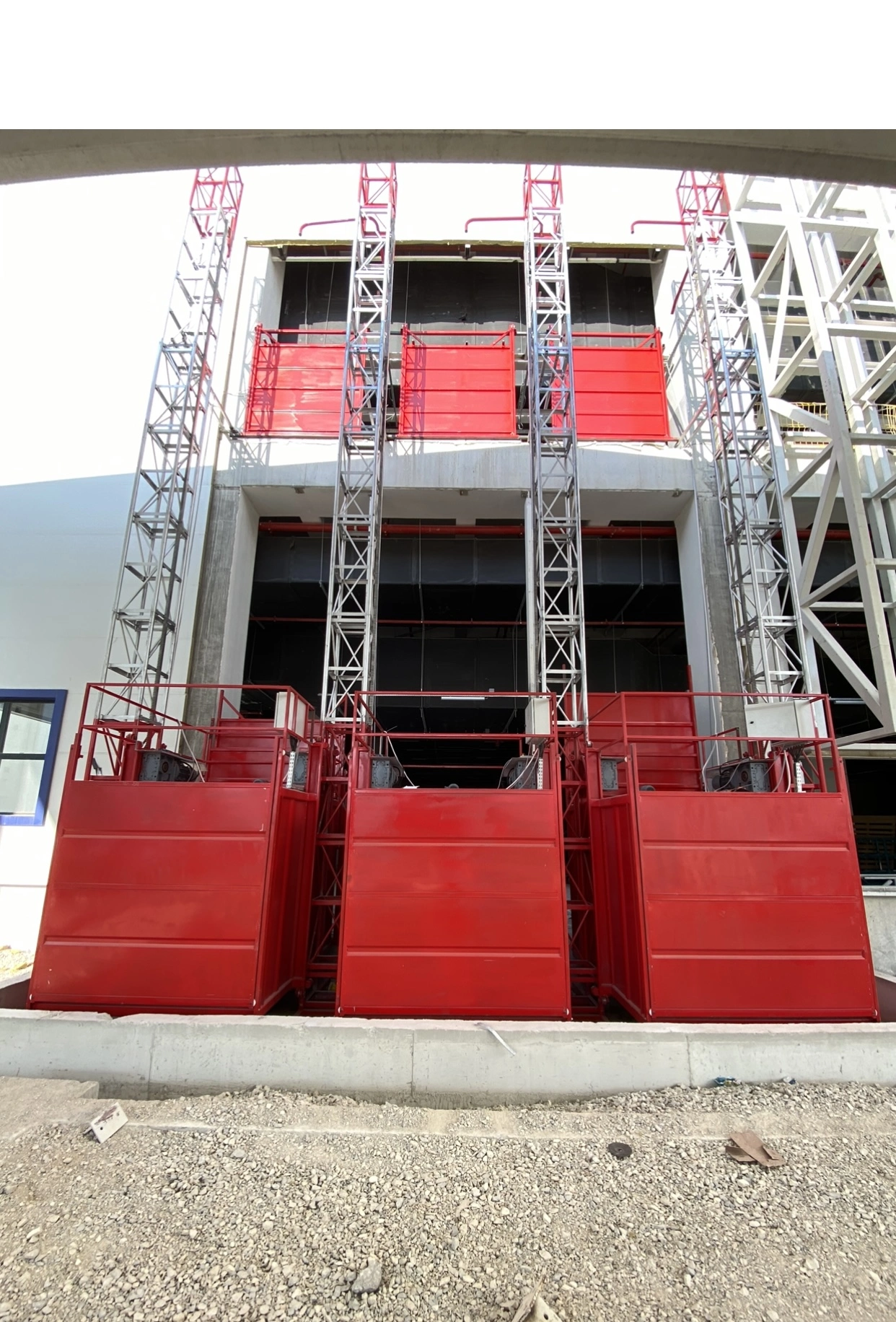
External rack-and-pinion systems can be configured with one cage or with two cages operating on the same mast arrangement. A twin-cage system can increase traffic capacity on busy sites by separating flows or reducing waiting time, while a single-cage installation may be more appropriate where space or traffic demand is lower.
5. Application-specific construction and industrial hoists
Some projects require configurations for harsh environments, restricted footprints, unusually large cages, high duty cycles or special structural interfaces. Mining, power, cement, silos and industrial plants can require different engineering choices from a conventional residential tower project.
How do you choose the right construction hoist?
Instead of selecting by name alone, compare the project against a short engineering checklist:
- Rated load: the heaviest expected combination of people, tools and materials.
- Travel height: the vertical distance and number of served landings.
- Cage dimensions: especially when moving long components, pallets or wheeled equipment.
- Traffic demand: how many trips per hour the site realistically needs.
- Landing arrangement: the building edge, scaffold interface, gates and access route at each level.
- Environment: wind exposure, dust, temperature, corrosion and other site conditions.
- Installation and service support: erection method, mast ties, inspections, spare parts and maintenance capability.
- Applicable conformity requirements: local legislation, standards and project specifications.
Single-cabin vs dual-cabin hoists: plan peak-hour transport
Start with the busiest transport period, not cabin count. A single cabin may be sufficient when its reviewed cycle plan covers personnel and material demand without unacceptable queues. Consider a dual-cabin arrangement when overlapping flows or concentrated demand justify a second cabin and the site can support both.
Build a transport brief
- Demand: record people, tools and material loads to move during the peak period, their destinations and required arrival times. Record material dimensions as well as mass; plan separate trips where the loading or operating rules require them.
- Route: record travel height, every served landing and the stops expected on each trip. A multi-stop run is not equivalent to a direct run to the highest floor.
- Handling: allow for boarding, loading, unloading, doors and gates, landing clearance and return preparation. Use site observations or an agreed logistics plan rather than assumed instant turnaround.
- Cycle: assess the outbound route, all stop activities, return travel and operational delays. Check the busiest direction and period rather than relying on a daily average.
Cycle time = outbound and return travel time + loading/unloading time + door/gate and stop time + operational delay allowance. Use consistent time units and avoid counting the same activity twice.
For a preliminary travel-only estimate, divide each route segment's distance by the selected speed and sum the segments. This does not include acceleration, deceleration or stops. A supplier-reviewed cycle plan is required before estimating completed trips in a peak period.
Compare the planned trips and usable load per trip with the required movements. Passenger count, combined payload, load dimensions and the approved operating rules must all be respected. Two cabins do not automatically deliver twice the actual throughput: shared landings, loading crews and access routes may remain the bottleneck.
| Decision factor | Single cabin | Dual cabin |
|---|---|---|
| Typical use case | A reviewed traffic plan that one cabin can serve; personnel and material trips can be scheduled. | Overlapping personnel/material demand or concentrated movement that warrants a second cabin. |
| Transport flexibility | One cabin serves the planned sequence of calls and loads. | Two cabins offer additional scheduling flexibility, subject to the approved arrangement and landing access. |
| Peak-hour suitability | Consider when the cycle plan covers demand and acceptable waiting time. | Consider when a single-cabin plan leaves a shortfall after realistic handling and stop allowances. |
| Site and logistics | Review base, anchoring, power, loading area and each landing. | Review the two-cabin structural/electrical configuration and whether crews and landings can service both. |
| Project review | Confirm usable payload, route, stops and operating conditions. | Confirm each cabin's duty and the shared interfaces; do not assume doubled productivity. |
SEKLIFT model reference
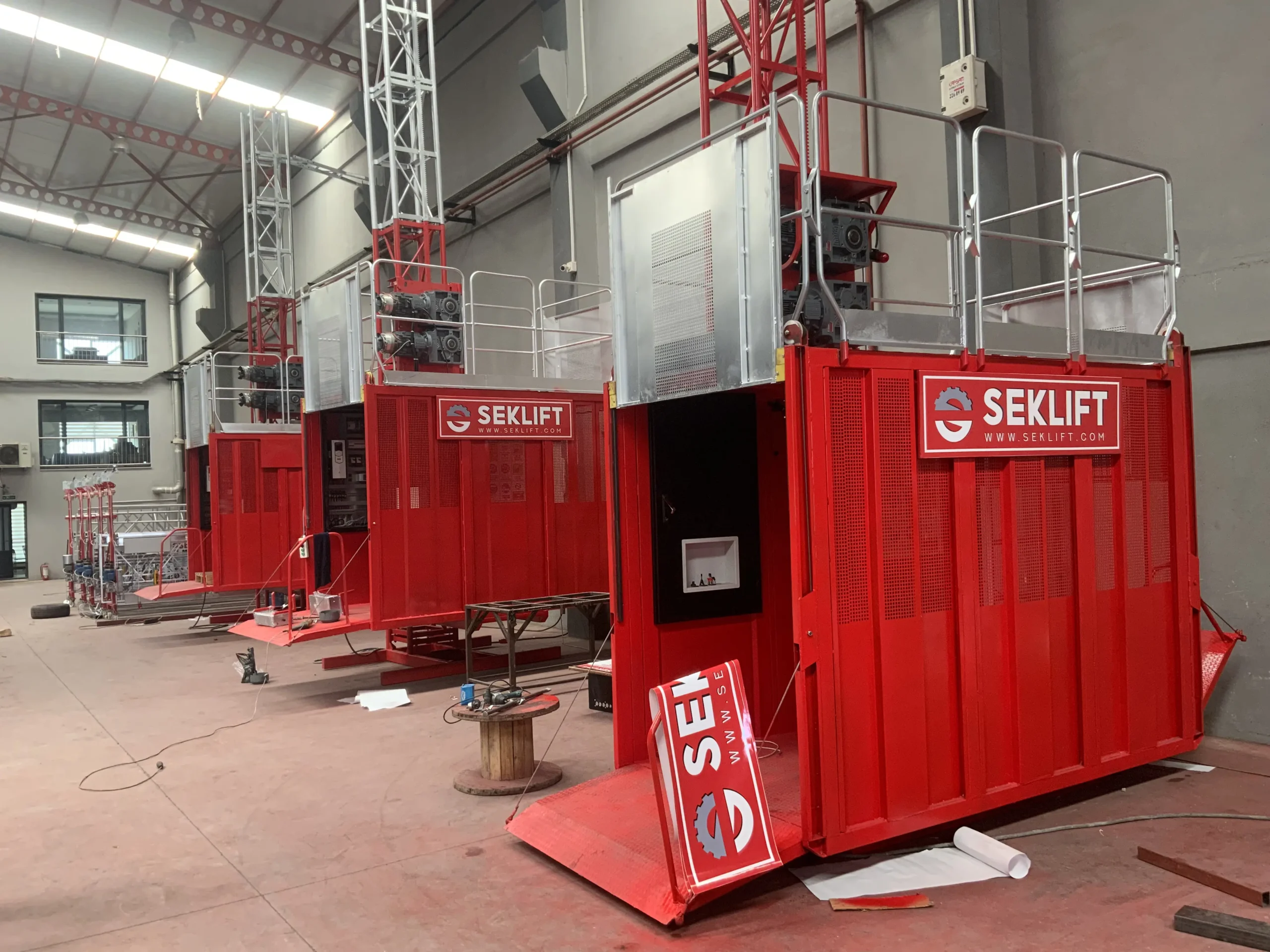
The published SM-GTP-101 specification states 2,500 kg and 23 persons per cabin, with selectable 36, 54 or 90 m/min speed. Its dual-cabin variant lists two equivalent cabins: 5,000 kg and 46 persons combined across the system. These are equipment ratings, not measured hourly output; they do not mean the full rated payload can be added to the maximum passenger load. Confirm the permissible loading combination and selected configuration with SEKLIFT.
Decision checklist
- Have peak personnel and material movements been separated by time and destination?
- Are all stops, handling activities, returns and delays included?
- Can the loading team and landings support the proposed cabin arrangement?
- Have payload, passenger limits, material dimensions, power and structural interfaces been reviewed?
- Does the proposed arrangement cover the peak requirement without relying on guaranteed cycles per hour?
Use the SEKLIFT construction-hoist model specifications as the equipment reference, then share the peak transport brief and landing plan for a project-specific configuration review.
What safety features matter?
Construction-hoist safety is not one component; it is a system. OSHA’s construction-hoist requirements address rated-load information, landing protection, car gates or doors, emergency stopping and safety devices for personnel hoists. HSE guidance similarly stresses proper construction, clear rated-use markings, competent erection and operation, landing gates, secure loads and routine checks.
For a project buyer, that means the specification should be reviewed as a complete package: machine safety devices, gates and interlocks, mast and tie design, landing interfaces, commissioning, inspection and operator procedures all matter.
Frequently asked questions
What type of construction hoist is used on high-rise buildings?
Passenger/material rack-and-pinion hoists are widely used for external vertical access on multi-storey projects. The final choice depends on travel height, rated load, cage size, traffic demand and local requirements.
Can a material hoist carry workers?
Not unless the specific equipment is designed, rated and permitted for passenger transport. Goods-only hoists must not be treated as passenger hoists.
Is a construction hoist the same as a freight elevator?
No. A construction hoist is generally temporary or project-specific site access equipment, while a freight elevator or goods lift is usually part of a building or industrial facility. The governing standards and design assumptions can differ.
Are all construction hoists hydraulic?
No. External construction hoists for multi-storey work commonly use rack-and-pinion systems. Hydraulic lifting equipment exists, but it is a different configuration and is not a universal description of construction hoists.
What information should I give a hoist manufacturer?
Provide required travel height, rated load, cage dimensions, expected passengers/materials, number of landings, site drawings, available power, environmental conditions and project schedule.
Review the SM-GTP-101 and SM-GTP-103 rack-and-pinion goods and personnel hoists, verified specifications, and project-specific configuration options. Then share your lifting height, load, cage and landing requirements for a quotation.
For procurement validation, review the SM-GTP-101 technical evidence note. Then send travel height, landing count, required load, intended passengers or materials, project country and site constraints through the technical enquiry form.
View SEKLIFT construction hoist models and specifications →Technical references
This article is general technical information, not a substitute for the machine manual, site risk assessment or locally applicable law.

One Response