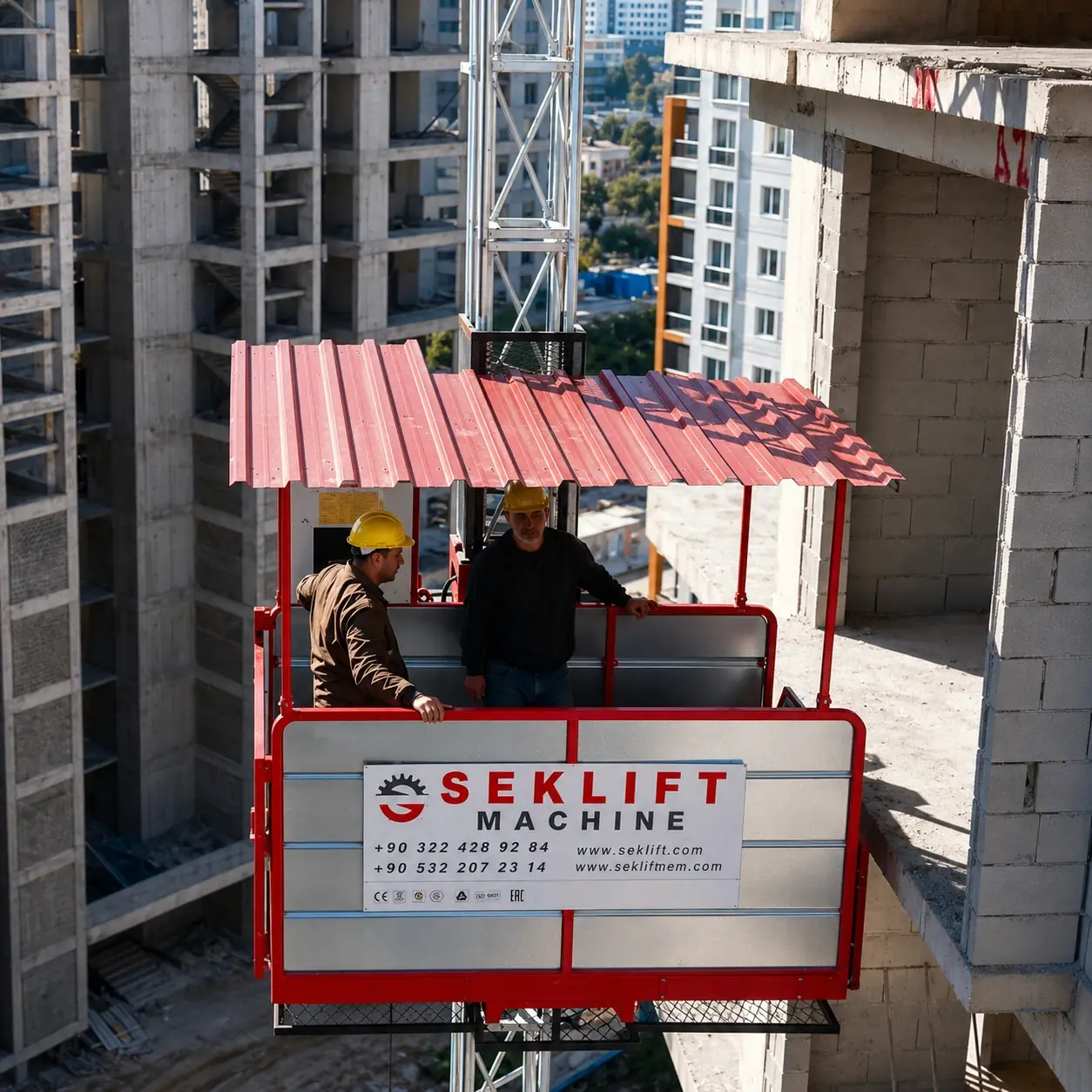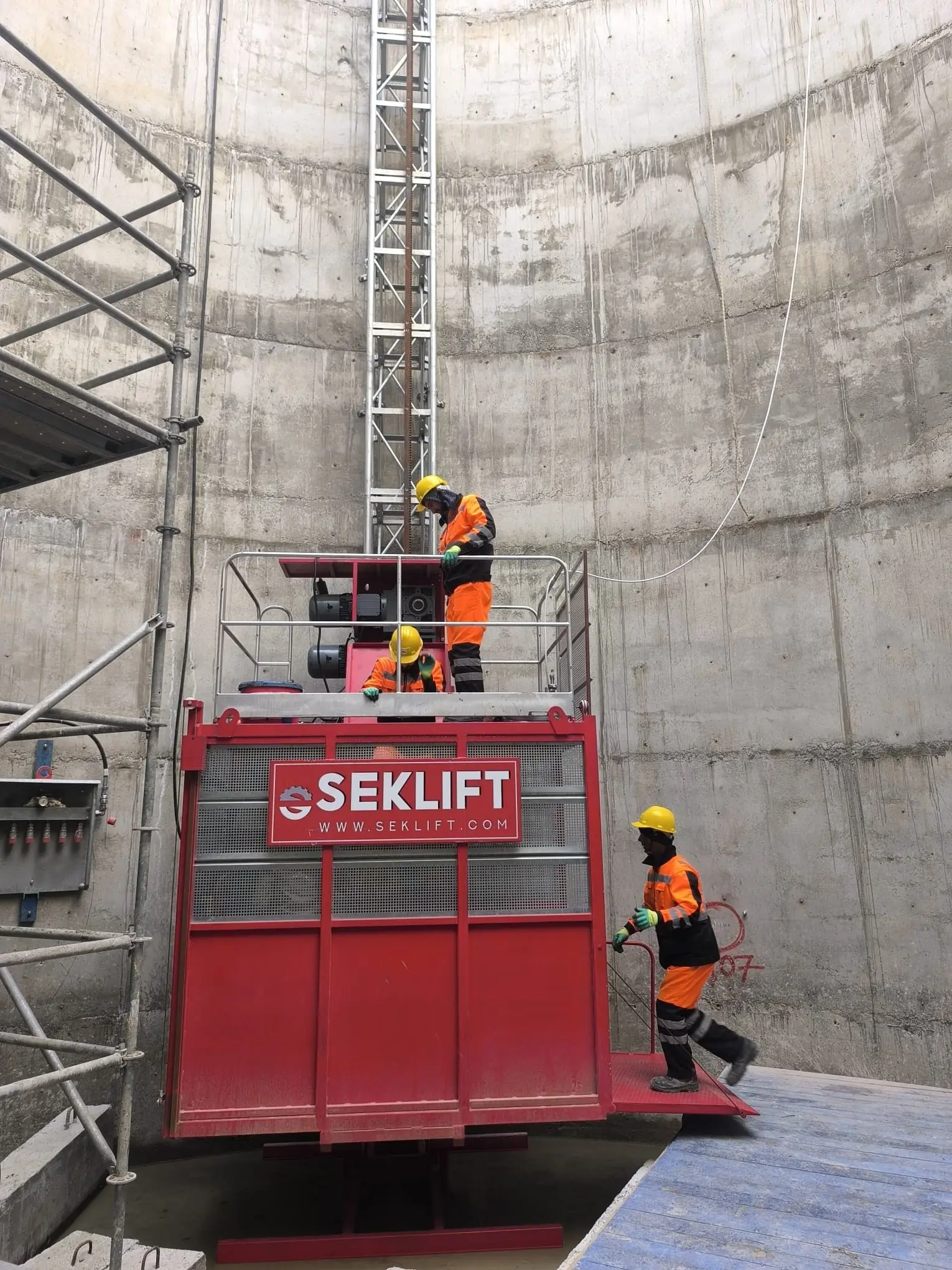
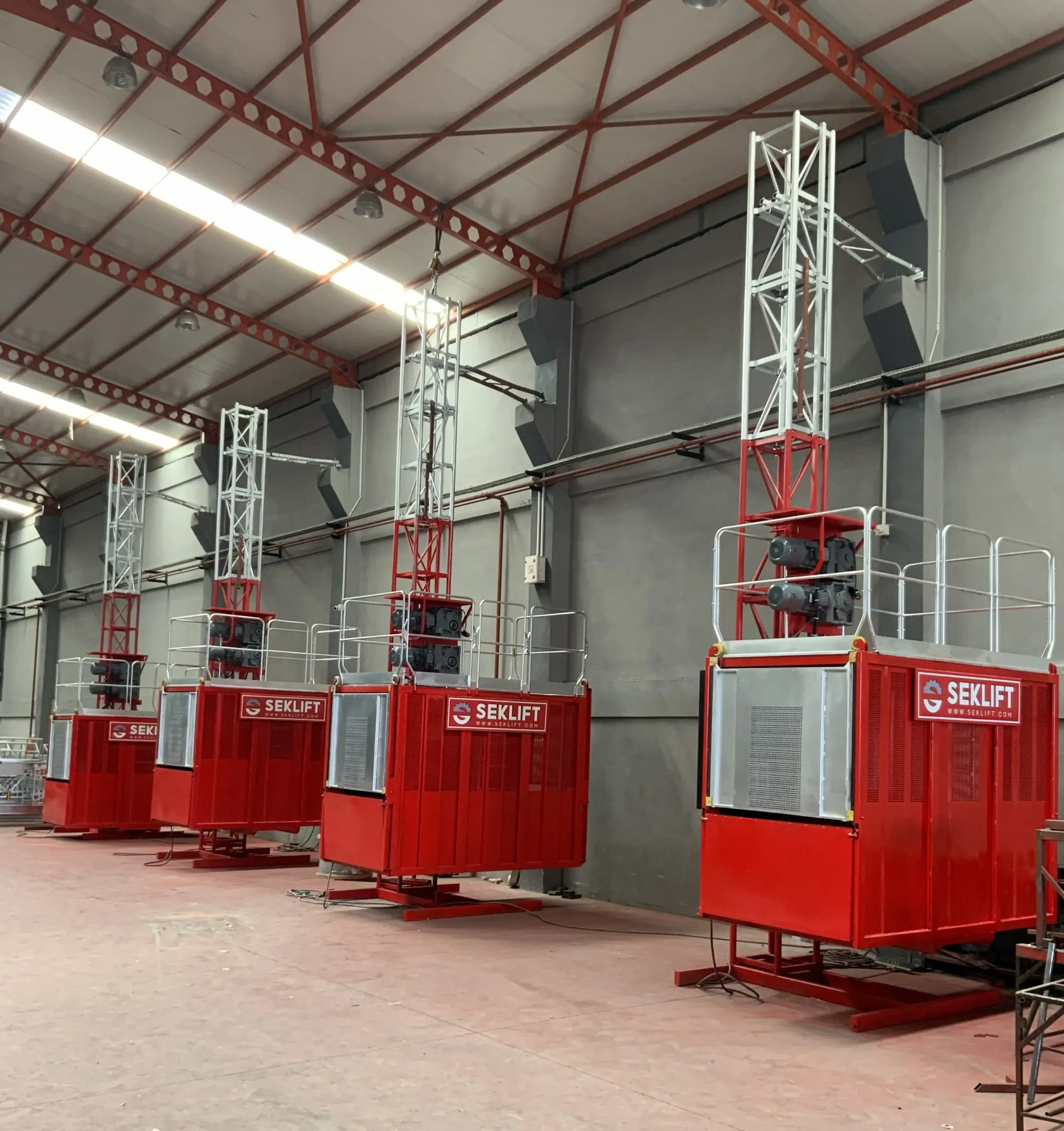
If you buy, rent or import a construction hoist for a European project, EN 12159 is the document that defines what “safe by design” means for it. It’s also one of the most misunderstood references in procurement. A supplier’s brochure saying “EN 12159” tells you very little until you know which edition, which model, and what evidence sits behind it.
This guide explains what the standard covers, how it fits into EU machinery law (including the Machinery Regulation (EU) 2023/1230, which applies from 20 January 2027), which other standards sit around it, and the documents a buyer should ask for.
In short
- EN 12159 = Builders hoists for persons and materials with vertically guided cages.
- The current edition is EN 12159:2024, which replaced EN 12159:2012.
- It is a harmonised product standard: following it gives a presumption of conformity with the relevant essential requirements of EU machinery law.
- It covers design and construction. Use, inspection and operator rules are national (e.g. LOLER in the UK, BetrSichV in Germany, periodic inspection rules in Türkiye).
What EN 12159 covers, and what it doesn’t
In scope: power-operated, temporarily installed builders’ hoists that carry persons, or persons and materials, in a cage that is guided and travels vertically or along a path within 15° of the vertical. The cage may be supported by rack and pinion, by drum-driven wire rope, or by an expanding linkage.
Out of scope (covered elsewhere):
| Equipment | Standard |
|---|---|
| Builders’ hoists for goods only | EN 12158-1 / EN 12158-2 |
| Permanent passenger and goods lifts | EN 81 series |
| Mast-climbing work platforms | EN 1495 |
| Suspended access equipment (cradles) | EN 1808 |
| Work cages suspended from cranes | Not EN 12159 |
This distinction matters in practice. A “goods hoist” can’t legally carry people just because the cage is big enough. And a temporary builders’ hoist isn’t automatically suitable as a permanent building lift.
What changed with EN 12159:2024
CEN approved the revised standard in June 2024, and it superseded the 2012 edition. National adoptions followed (for example DIN EN 12159:2024-11 in Germany and SS-EN 12159:2024 in Sweden). The revision work brought the standard up to date with current technology, and it deals more explicitly with the hoist installation, including landing gates and their frames.
What this means for buyers: ask which edition a hoist’s EC type-examination and Declaration of Conformity refer to. A hoist designed and certified to the 2012 edition isn’t non-compliant just because a newer edition exists. Machinery already placed on the market isn’t re-certified each time a standard is revised. But for new procurement and tenders, it’s reasonable to ask how the supplier is addressing the 2024 changes.
Where EN 12159 sits in EU machinery law
Machinery Directive 2006/42/EC (until 19 January 2027)
Construction hoists are machinery. Under Directive 2006/42/EC, devices for lifting persons, or persons and goods, with a hazard of falling from a vertical height of more than 3 m are listed in Annex IV, the list of higher-risk machinery. For these machines the manufacturer typically involves a Notified Body, for example through an EC type-examination, before affixing the CE mark.
Machinery Regulation (EU) 2023/1230 (from 20 January 2027)
The Regulation replaces the Directive and applies directly in every Member State from 20 January 2027. For hoist users, the key points are:
- Machinery placed on the EU market from that date must meet the Regulation’s requirements.
- The list of higher-risk machinery and the conformity-assessment routes are reorganised (Annex I of the Regulation). Manufacturers of person-lifting equipment need to confirm the applicable route.
- Instructions may be supplied in digital form, with a paper copy available on request.
- Harmonised standards such as EN 12159 continue to be the main way to demonstrate conformity, once they are cited for the Regulation.
Other EU legislation that applies to the electrical side
- EMC Directive 2014/30/EU: electromagnetic compatibility of the control system and drives.
- Low-voltage safety objectives: covered for machinery through the essential requirements of machinery law.
In Türkiye, the Machinery Directive is transposed as the Makine Emniyeti Yönetmeliği (Machinery Safety Regulation), which is why Turkish manufacturers exporting to the EU work within the same CE framework.
The standards that sit next to EN 12159
EN 12159 is a “type-C” product standard. It refers to general machinery-safety standards for specific subjects. The SM-GTP-101 Personnel & Material Hoist, for example, is designed to this set:
| Standard | Type | Subject |
|---|---|---|
| EN 12159 | C | Builders’ hoists for persons and materials |
| EN ISO 12100 | A | General principles: risk assessment and risk reduction |
| EN ISO 13849-1 | B | Safety-related parts of control systems |
| EN ISO 13850 | B | Emergency stop function |
| EN ISO 13854 | B | Minimum gaps to avoid crushing of parts of the body |
| EN ISO 14120 | B | Guards: fixed and movable |
| EN 60204-1 | B | Electrical equipment of machines: general requirements |
| EN 60204-32 | B | Electrical equipment: requirements for hoisting machines |
| ISO 9001 | — | Quality management system of the manufacturer |
Type A = basic safety concepts; type B = generic safety aspects or devices; type C = specific machine type.
What EN 12159 means in hardware terms
A standard reads abstractly until you see it on the machine. These are the features you’d expect on a hoist designed to EN 12159. We explain each one in Construction hoist safety devices.
- An independent overspeed safety device that stops the cage on the mast.
- Brakes that engage automatically when power is lost, plus a means of emergency lowering.
- Overload detection that prevents travel when the cage is overloaded.
- Interlocked cage and base-enclosure doors.
- Limit and final-limit switches at the ends of travel.
- Mechanical retention so the cage can’t leave the guides or lose rack engagement.
- Buffers at the base.
- Defined wind limits for operation and for erection.
- Instructions covering erection, tying, testing, use, inspection and dismantling.
Documents to request before you buy, rent or import
| Document | What to check |
|---|---|
| EU/EC Declaration of Conformity | Names the exact model (and serial no.), the legislation, and the harmonised standards with their editions |
| EC type-examination certificate | Issued by a Notified Body, covers this model, and is valid. A certificate for another model is not evidence |
| CE marking and rating plate | On the machine: model, serial, rated load, year, manufacturer |
| Instruction manual | In the language of the country of use; covers erection, tying, testing, operation, maintenance and dismantling |
| Layout / foundation / tie documentation | Project-specific; confirms foundation loads and tie positions for your building |
| Commissioning and load-test record | After erection on your site, before first use |
| Quality-system certificate | e.g. ISO 9001 for the manufacturing company |
SEKLIFT publishes its certificates on the Certifications page. For example, the SM-GTP-101 holds EC type-examination certificate CAC-M-0001-3 to EN 12159:2012 under Directive 2006/42/EC (Notified Body 2828, valid to 29 June 2027), and the company is certified to ISO 9001:2015. That’s what a buyer should expect to see: a named model, a certificate number, the standard with its edition, the Notified Body number and a validity date. The CE Declaration of Conformity and the operating manual (TR/EN) ship with every machine.
EN 12159 is about design. Use and inspection are national.
A CE-marked hoist still has to be erected, examined and used under the rules of the country where it works:
- United Kingdom: LOLER 1998. Lifting equipment for people needs a thorough examination at least every 6 months, and after installation. See HSE guidance.
- Germany: see our article on construction hoist inspection in Germany.
- Türkiye: see construction hoist periodic inspection in Türkiye.
- Brazil: NR-18 has its own hoist requirements; see rack-and-pinion hoists and NR-18.
- United States: EN 12159 isn’t the reference. OSHA 29 CFR 1926.552 and ANSI A10.4 apply. A CE mark alone doesn’t establish US compliance.
Frequently asked questions
What is EN 12159?
It’s the European harmonised standard for builders’ hoists for persons and materials with vertically guided cages. It sets design and construction safety requirements for temporary construction hoists that carry people.
Is EN 12159:2012 still valid?
The 2012 edition was superseded by EN 12159:2024. Hoists already designed and placed on the market to the 2012 edition aren’t automatically non-compliant, but buyers should check which edition the certificates reference.
Does EN 12159 apply to goods-only hoists?
No. Goods-only builders’ hoists are covered by EN 12158-1 and EN 12158-2.
What changes for construction hoists in January 2027?
The EU Machinery Regulation (EU) 2023/1230 replaces the Machinery Directive 2006/42/EC for machinery placed on the market from 20 January 2027. CE marking continues, under the new legal basis.
Does a CE mark mean a hoist can be used anywhere in the world?
No. CE marking shows conformity with EU law. Other markets have their own rules, such as OSHA and ANSI in the US, or NR-18 in Brazil, plus national inspection requirements.
Tell us the country of installation, building height and load. We’ll confirm which documentation package applies to the configuration we offer.
Request documentation →Sources
- EUR-Lex, Directive 2006/42/EC on machinery (Annex IV).
- EUR-Lex, Regulation (EU) 2023/1230 on machinery (Art. 54; the original text says 14 January 2027, corrected to 20 January 2027 by a corrigendum).
- European Commission, Machinery: Regulation (EU) 2023/1230 (applies on a mandatory basis from 20 January 2027).
- EU-OSHA, Regulation (EU) 2023/1230: machinery.
- European Commission, Harmonised standards: Machinery.
- SIS, SS-EN 12159:2024 listing; DIN Media, DIN EN 12159:2024-11.
- EUR-Lex, Directive 2014/30/EU (EMC).
- HSE, LOLER.
- OSHA, 29 CFR 1926.552.