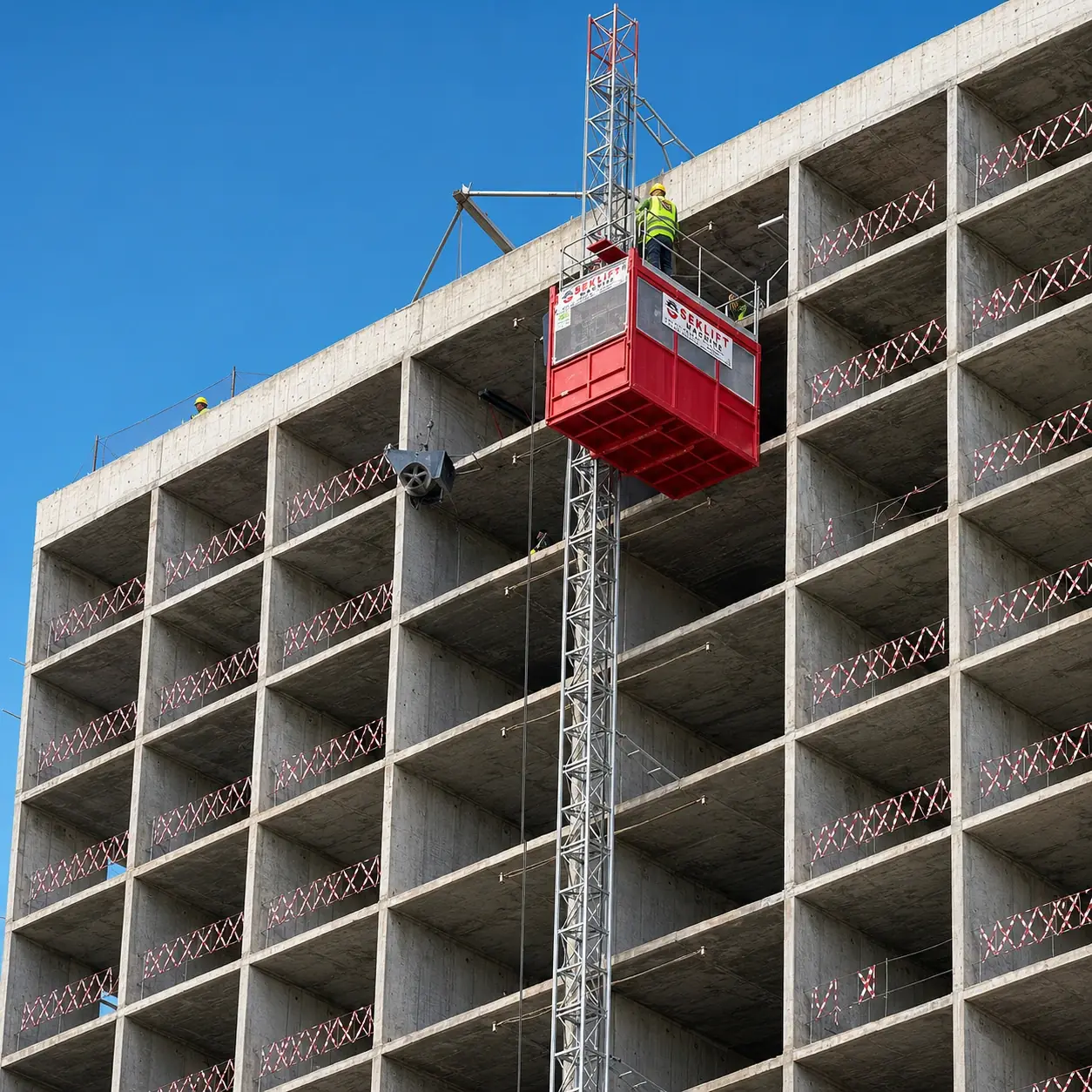
Every construction hoist has two wind limits, and on tall sites the wind at the cage can be 40–80 % stronger than the wind you feel at the gate. If you get either point wrong, a hoist that’s perfectly compliant on paper can end up operating outside its design envelope.
This article explains both limits, converts them into every unit you’ll meet on a forecast, and shows how to translate a ground-level forecast into the wind at cage height.
SM-GTP-101 wind limits
In service: max. 72 km/h (20 m/s) · Erection / dismantling: max. 45 km/h (12.5 m/s)
Two limits, two different risks
| In-service limit | Erection / dismantling limit | |
|---|---|---|
| Applies when | The hoist is carrying people or materials | The mast is being extended or dismantled, or ties are being installed or removed |
| SM-GTP-101 value | 72 km/h | 45 km/h |
| Why it exists | Wind adds lateral load to the cage, mast and ties, and can make loading at landings unsafe | People work on the cage roof, handle mast sections, and the top of the mast is temporarily untied |
| When exceeded | Stop service, bring the cage to the bottom landing, secure it | Stop erection work; don’t leave the mast in a partly erected state beyond what the instructions allow |
The erection limit is lower because the structure is at its most vulnerable during erection. The mast above the last tie is free-standing, and crews are exposed at height while handling 87 kg sections.
Conversion table: what the limits look like on a forecast
| Limit | km/h | m/s | knots | mph | Beaufort |
|---|---|---|---|---|---|
| In service | 72 | 20.0 | 38.9 | 44.7 | Force 8, upper end (“gale”, 17.2–20.7 m/s) |
| Erection | 45 | 12.5 | 24.3 | 28.0 | Force 6 (“strong breeze”, 10.8–13.8 m/s) |
Beaufort ranges from the UK Met Office scale.
Forecasts give a mean speed and a gust speed. Unless the manufacturer’s instructions specify otherwise, plan against the gusts: a hoist cage sees every gust, not the 10-minute average.
Wind increases with height
Weather forecasts and most site anemometers report wind at about 10 m above ground. Wind speed increases with height because ground friction slows the air near the surface. A common engineering approximation is the power law:
v(z) = v₁₀ × (z ÷ 10)^α
where v₁₀ is the wind at 10 m, z is the height in metres, and α depends on the terrain, roughly 0.14 for open country or coast and 0.2–0.3 for city centres (where the profile starts lower but rises further).
Example: a forecast of 50 km/h at 10 m
| Cage height | Open terrain (α = 0.14) | Urban terrain (α = 0.22) |
|---|---|---|
| 10 m | 50 km/h | 50 km/h |
| 30 m | 58 km/h | 64 km/h |
| 50 m | 63 km/h | 71 km/h |
| 100 m | 69 km/h | 83 km/h ⚠ |
| 150 m | 73 km/h ⚠ | 91 km/h ⚠ |
⚠ = above the 72 km/h in-service limit.
Turned around: the highest 10 m wind at which you’re still inside the limit
| Cage height | In service (72 km/h), open / urban | Erection (45 km/h), open / urban |
|---|---|---|
| 30 m | 62 / 57 km/h | 39 / 35 km/h |
| 50 m | 57 / 51 km/h | 36 / 32 km/h |
| 100 m | 52 / 43 km/h | 33 / 27 km/h |
| 150 m | 49 / 40 km/h | 31 / 25 km/h |
These figures are an engineering approximation for planning only. Local effects such as corner acceleration around towers, funnelling between buildings, and exposed ridges can be stronger than the power law predicts. They’re no substitute for a measurement at cage height.
The practical lesson: on a 100 m urban tower, a ground forecast of only about 45 km/h can already mean the cage is at the in-service limit, and erection work should stop at around 27 km/h at ground level.
Good practice on site
- Measure where the risk is. On tall projects, fit an anemometer at or near the top of the mast or on the cage roof, with a readout for the operator, rather than relying on a ground-level reading.
- Use gusts, not averages. Set your stop criteria on gust readings.
- Have a written wind procedure. It should say who decides, at what reading, what happens to the cage (bottom landing, doors closed, power isolated), and how service is resumed after an inspection.
- Plan erection days around the forecast. Mast extensions and tie changes need the lower limit, so schedule them for calm periods, not on a breezy afternoon at the end of the week.
- Inspect after storms. After very high winds, have a competent person inspect the ties, mast joints and cage before service resumes.
- Watch the loads. Large panels (plasterboard, glazing, formwork) act as sails at landings. Handle them with extra care even below the hoist limit.
In service, out of service, and storms
The 72 km/h figure is the limit for operating the hoist. Storm winds when the hoist is out of service are a separate design case. The mast, ties and parked cage must survive them, and the design value depends on the site’s location and height. If your project is in a region exposed to typhoons, hurricanes or extreme coastal winds, give us the location at enquiry stage so the tie layout can be checked for it.
Frequently asked questions
What is the maximum wind speed for operating a construction hoist?
It’s set by the manufacturer for each model. For the SEKLIFT SM-GTP-101, the in-service limit is 72 km/h (20 m/s). Check it against the wind the cage actually experiences at height, not the ground-level reading.
Why is the erection wind limit lower?
During erection, crews work on the cage roof and the top of the mast is temporarily free-standing above the last tie. The SM-GTP-101 erection and dismantling limit is 45 km/h (12.5 m/s).
Is wind at the top of a building stronger than at ground level?
Yes. Wind usually increases with height. At 100 m it’s often around 40–70 % stronger than the 10 m value reported in forecasts, depending on the terrain.
Should I use mean wind speed or gust speed?
Unless the instructions say otherwise, use gusts. The hoist experiences every gust, and gusts can be much higher than the mean.
What should happen to the hoist when wind exceeds the limit?
Stop operation, return the cage to the bottom landing, close all doors, isolate the power, and resume only after the wind drops and the hoist has been checked according to your site procedure. Ask about a configuration for an exposed or high-rise site → · Safety devices explained · Mast sections and wall ties · Construction hoists
Tell us the building height, location and programme. We will confirm the configuration and the wind limits that apply to it.
View construction hoist models →Sources
- SEKLIFT, SM-GTP-101 Technical Data Sheet, DS-SM-GTP-101 Rev. 2, 10.2026: operating conditions.
- Met Office, Beaufort wind force scale.
- CEN, EN 12159 Builders hoists for persons and materials with vertically guided cages (current edition EN 12159:2024).
- The power-law wind profile is a standard engineering approximation. For design, use the wind provisions of the applicable structural code (e.g. EN 1991-1-4 in Europe).